Start Here
How many chickens can I have in my backyard?
Whichever is lower: the number your municipality allows, or the number your yard has space for. Both are findable in an afternoon.
Chickens & Coops earns a commission when you buy through our links, at no extra cost to you. Prices come from Amazon and change; the date beside every price is when we last verified it. Full disclosure.
Top pick
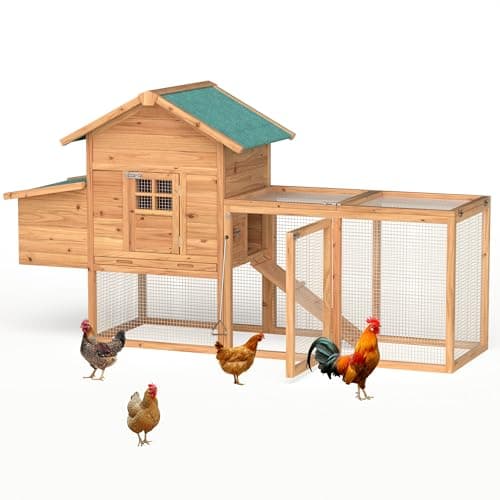
GOJOOASIS Wooden Hen House (2-5 hens)
A conventional raised wooden hutch with a pull-out tray, stated for 2-5 birds.
#ad How we are funded · Price as of November 8, 2026
Quick picks
| # | Product | Stated capacity | Score | Price |
|---|---|---|---|---|
| Rank 1 | GOJOOASIS Wooden Hen House (2-5 hens) A simple, cheap first coop with a pull-out tray | 2-5 chickens | 8.5 | $169.99GOJOOASIS Wooden Hen |
| Rank 2 | 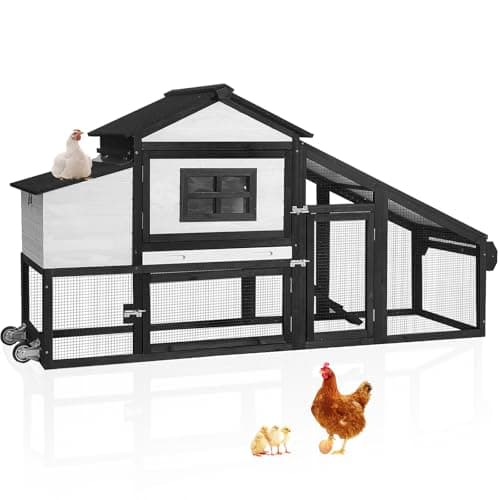 Aivituvin Mobile Chicken Coop with Wheels (2-4 hens) A starter flock you want to move around the lawn | 2-4 chickens | 8.7 | $174.99Aivituvin Mobile |
| Rank 3 | 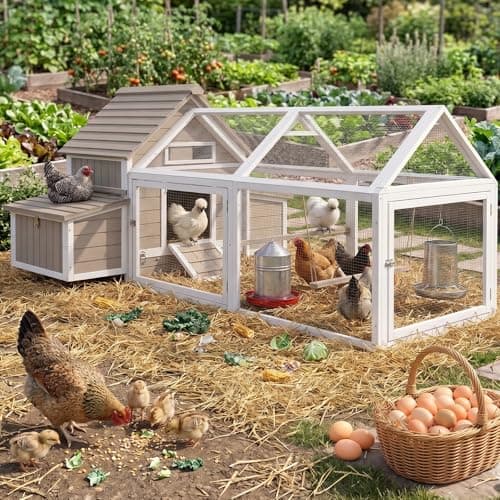 Ketive 83-inch Chicken Coop with Run (4-6 hens) The most run length per dollar at six hens | 4-6 chickens | 8.7 | $159.99Ketive 83-inch |
#ad Prices come from Amazon and change. How this site is funded. Scores are our own published rubric, not a lab test — see how we pick.
The answer is the lower of two numbers: the maximum your local ordinance permits, and the number your available space supports at 2 sq ft of coop floor and 10 sq ft of run per large bird. Rules vary enormously between municipalities — there is no national figure, and anyone who gives you one is guessing — so the ordinance has to be looked up for your own address. The space arithmetic, on the other hand, is the same everywhere.
Do the legal half first. It is the step people skip, and it is the one that can end the whole project after the coop has been bought.
Finding the rule that applies to you
Backyard poultry is regulated locally, usually through the zoning code or an animal-keeping ordinance, and sometimes through a separate permit. Four places to look, in order:
- Your municipality's code of ordinances, searchable online for most towns and cities. Search the code for "poultry", "fowl", "chickens" and "livestock" — the relevant section often uses an older word than you expect.
- The zoning ordinance for your specific parcel, because the rule frequently depends on your lot's zoning district and sometimes on its size.
- The city or county clerk, or the planning department. A phone call settles in ten minutes what an hour of searching may not, and it also tells you whether a permit exists.
- Your HOA covenant, if you have one. An HOA can prohibit what the municipality permits, and it is a contract rather than a law, so the municipality will not help you with it.
What these rules usually restrict
The categories below are the ones that recur. Which of them apply to you, and with what numbers, is specific to your jurisdiction — this is a checklist of questions to ask, not a set of answers:
- A maximum number of birds, sometimes scaled to lot size.
- Roosters, which are very commonly prohibited where hens are allowed. You do not need one for eggs — a rooster only makes them fertile.
- Setback distances between the coop and property lines, dwellings or neighboring houses.
- Coop size, siting or screening requirements, occasionally including a maximum structure size before a building permit applies.
- A permit or registration, sometimes with a fee and sometimes with neighbor notification.
- Slaughter, sale of eggs, and manure handling, which are often addressed separately from keeping.
- Nuisance provisions, which apply regardless of the bird limit and are the route most complaints actually travel.
Then the space arithmetic
Penn State Extension publishes the per-bird figures this whole site is built on: 2 sq ft of coop floor and 10 sq ft of outside run for a large chicken, and 1.5 sq ft inside and 8 sq ft out for laying hens of lighter breeds. It also gives six inches of perch space per standard bird and two nests for the first four hens, then one more per four hens after that.
| Birds | Coop floor (large breeds) | Run | Roost length | Nest boxes |
|---|---|---|---|---|
| 3 hens | 6 sq ft | 30 sq ft | 18 in | 2 |
| 4 hens | 8 sq ft | 40 sq ft | 24 in | 2 |
| 6 hens | 12 sq ft | 60 sq ft | 36 in | 3 |
| 8 hens | 16 sq ft | 80 sq ft | 48 in | 3 |
| 10 hens | 20 sq ft | 100 sq ft | 60 in | 4 |
| 12 hens | 24 sq ft | 120 sq ft | 72 in | 4 |
Measure the area you can actually give over to a run, divide by ten, and that is your spatial ceiling for large breeds. A 100 sq ft corner of a yard supports ten standard hens on the published figures, or a little more with lighter breeds — and far fewer if you want lawn left over.
The minimum, which matters as much as the maximum
Chickens are flock animals and a single hen does badly alone. Three is a sensible minimum: it leaves you a flock if you lose one, and it gives the birds a social group rather than a pair. Two works and is common; one is not a reasonable plan unless the bird is genuinely a pet with constant company.
On the other side, how many you actually want is usually set by eggs rather than by limits. A productive hen in her first year lays most days in season, so three to four hens covers an average household's egg use with some to give away. How many chickens should I get works through that calculation, and how often chickens lay covers what to expect across a year.
Coops for a small permitted flock
Three coops sized for the small flocks a restrictive ordinance tends to allow. Halve any marketed capacity before you trust it — every one of these states a bird count and none states a floor area.
#1 · A simple, cheap first coop with a pull-out tray
#ad How we are funded · Price as of November 8, 2026
GOJOOASIS Wooden Hen House (2-5 hens)
GOJOOASISA conventional raised wooden hutch with a pull-out tray, stated for 2-5 birds. Sensible for two or three hens with a separate run; five is optimistic.
| Stated capacity | 2-5 chickens |
|---|---|
| Construction | Wood, raised on legs |
| Cleaning | Pull-out tray |
| Nesting box | Yes, integrated |
| Floor area | Not published by manufacturer |
Specifications per Manufacturer figures as published on the Amazon product listing, as published at the date above.
Why we picked it
- Raised design puts the floor above ground damp and gives the birds shade underneath
- Pull-out tray is the feature that decides whether you actually clean a coop weekly
- Simple construction means fewer parts to fail and easy repairs with offcuts
Good to know — Stated 2-5 capacity is a wide range; plan for the low end
Our rubric
- Space per bird
- 7.9
- Predator resistance
- 7.9
- Ventilation
- 8.4
- Cleaning access
- 9.3
- Build
- 8.4
- Value
- 9.3
#2 · A starter flock you want to move around the lawn
#ad How we are funded · Price as of November 8, 2026
Aivituvin Mobile Chicken Coop with Wheels (2-4 hens)
AivituvinA wheeled, expandable coop-and-run for 2-4 birds. The wheels are the point: moving it weekly stops the ground underneath turning to bare mud, which is the usual fate of a fixed small run.
| Stated capacity | 2-4 chickens |
|---|---|
| Nesting boxes | 2 |
| Mobility | Wheels fitted |
| Run | Attached, expandable |
| Floor area | Not published by manufacturer |
Specifications per Manufacturer figures as published on the Amazon product listing, as published at the date above.
Why we picked it
- Wheels mean you can rotate it and let grass recover — a real husbandry advantage, not a gimmick
- Attached run means it works out of the box without building a second enclosure
- Two nest boxes for up to four hens is correct, not padded
- Expandable run section adds space without replacing the coop
Good to know — No floor-area figure published, so capacity has to be taken on trust
Our rubric
- Space per bird
- 8.4
- Predator resistance
- 7.9
- Ventilation
- 8.9
- Cleaning access
- 8.9
- Build
- 8.9
- Value
- 9.3
#3 · The most run length per dollar at six hens
#ad How we are funded · Price as of November 8, 2026
Ketive 83-inch Chicken Coop with Run (4-6 hens)
Ketive83 inches of coop-and-run for 4-6 birds. The published length is the useful number here: it is one of the few listings in this band that tells you the footprint before you buy.
| Stated capacity | 4-6 chickens |
|---|---|
| Overall length | 83 in |
| Run | Attached |
| Construction | Wood frame |
| Nesting box | Yes, integrated |
Specifications per Manufacturer figures as published on the Amazon product listing, as published at the date above.
Why we picked it
- Published overall length, so you can mark it out on the lawn before ordering
- Long, narrow footprint fits down the side of a house where square coops will not
- Run and house in one purchase
Good to know — 83 inches total includes the run, so the house itself is small for six hens
Our rubric
- Space per bird
- 8.4
- Predator resistance
- 7.9
- Ventilation
- 8.9
- Cleaning access
- 8.9
- Build
- 8.4
- Value
- 9.8
If your limit is low
- Choose a productive breed rather than a pretty one. Four good layers beat six ornamental birds on eggs. Best chickens for eggs.
- Buy the coop for the number you are allowed, not the number you would like. An undersized coop is the root cause behind most backyard flock problems.
- Mind the setback before you site it. Moving a built coop is a bad afternoon.
- Keep it quiet and clean. Nuisance complaints, not bird counts, are what usually bring an ordinance to a keeper's attention. Chicken coop smell fix and how to clean a chicken coop are the relevant habits.
- Tell your neighbors before the birds arrive, and give them eggs. This is not a legal measure and it is the single most effective one.
What we would do
Look up the ordinance and call the clerk this week. Measure the run area you are willing to give up, divide by ten, and compare the two numbers. Buy a coop sized for the lower one, with the marketed capacity halved, and start with three or four hens — a flock that is comfortably within both limits is a flock you will still be enjoying in a year. The full first-purchase list is in the chicken starter checklist.
Frequently asked questions
How many chickens can I have in my backyard?
How do I find out if chickens are allowed where I live?
Do I need a permit to keep chickens?
Are roosters usually allowed?
What is the minimum number of chickens to keep?
How many chickens fit in a 100 square foot run?
Our recommendation
If you buy one thing from this page, buy the first one. The second is here because it is the alternative worth weighing against it, not because a list needs two entries.
Top pick
GOJOOASIS Wooden Hen House (2-5 hens)
A simple, cheap first coop with a pull-out tray
#ad How we are funded · Price as of November 8, 2026
Runner-up
Aivituvin Mobile Chicken Coop with Wheels (2-4 hens)
A starter flock you want to move around the lawn
#ad How we are funded · Price as of November 8, 2026
Sources
Read next
Start Here
How many chickens should I get?
Flock sizing by household, yard and coop, with the space figures and the honest note about flocks growing.
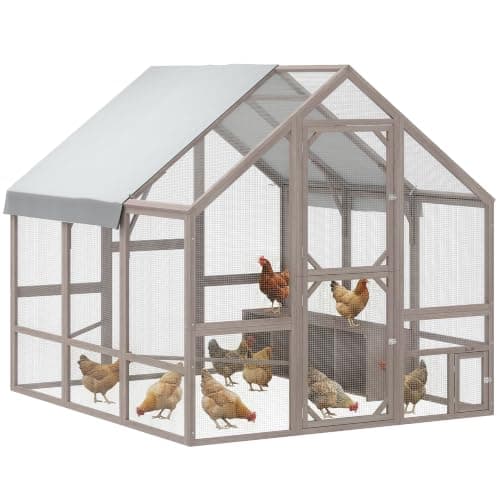
Chicken Coops
Chicken coop size per chicken: the real numbers
The sizing table the rest of this site is built on, with the extension sources and a method for checking any listing.
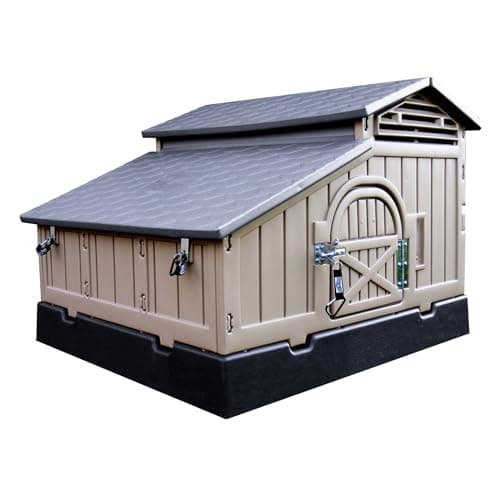
Start Here
Raising chickens for beginners
The pillar guide for a first flock: how many birds, what they need, what it costs, and what to get right first.
Chicken Coops
The best chicken coops for 4 chickens
Four hens is the sweet spot for a suburban yard. These coops hit 8 sq ft of floor honestly.
Start Here
Chicken starter checklist
The full starter list, split into day-one essentials and things that can wait, with the sizing figures for each.
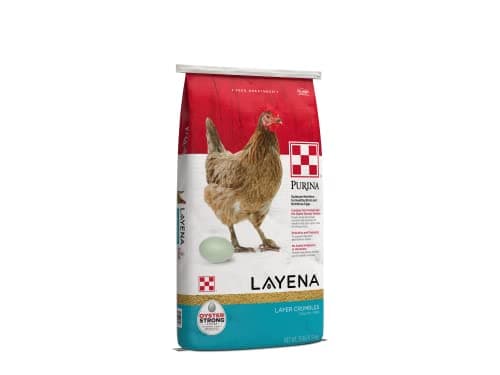
Start Here
Chickens vs rabbits
Space, feed, output, timeline and the part nobody enjoys — with Penn State Extension's published rabbit figures set against the chicken figures this site uses everywhere.