Chicken Coops
Chicken coop size per chicken: the real numbers
Two square feet inside, ten outside, six inches of roost. Here is where those figures come from and how to check a coop against them.
Chickens & Coops earns a commission when you buy through our links, at no extra cost to you. Prices come from Amazon and change; the date beside every price is when we last verified it. Full disclosure.
Quick picks
| # | Product | Floor area | Score | Price |
|---|---|---|---|---|
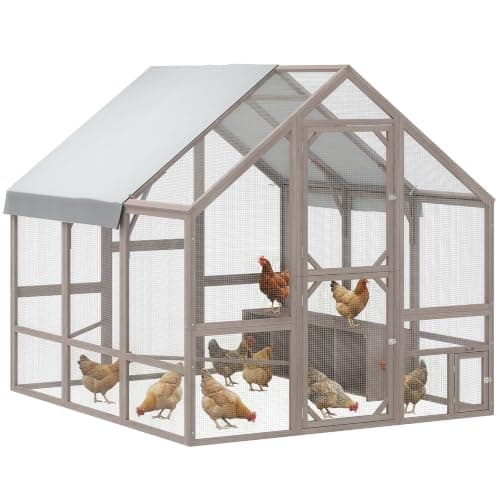
| Rank 1 | PawHut Large Wooden Chicken Coop, 83in x 73in x 73in Eight to ten hens in a coop you can walk into | Not published | 7.7 | $379.99on Amazon |
| Rank 2 | 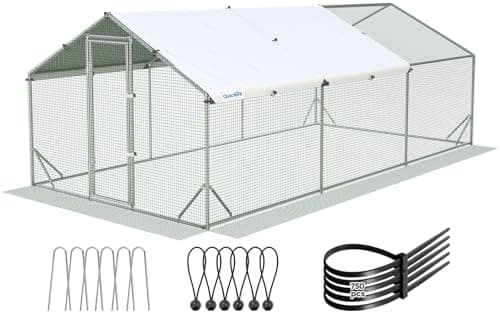 Quictent 18 x 9 x 6.6ft Metal Coop Run with Hardware Cloth The best predator-resistant run at walk-in height | 162 sq ft | 8.7 | $289.99on Amazon |
| Rank 3 | 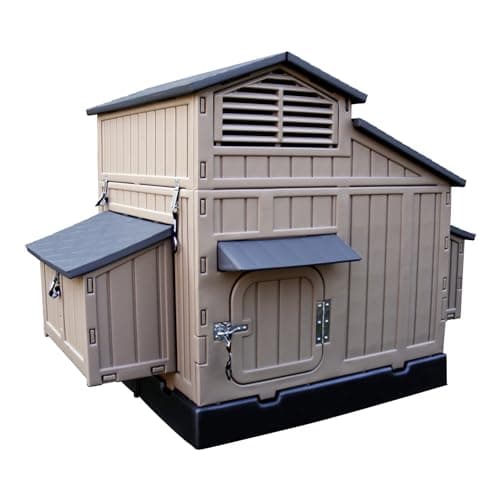 Hatching Time Formex Snap Lock Large Coop (4-6 hens) Six hens in a coop you can pressure-wash | Not published | 7.7 | $824.99on Amazon |
#ad Prices come from Amazon and change. How this site is funded. Scores are our own published rubric, not a lab test — see how we pick.
Almost every disappointment in backyard chicken keeping traces back to a coop that was too small. Crowded birds pick feathers, bully each other, lay in corners instead of boxes, and get sick more. None of that is a mysterious husbandry problem — it is arithmetic that was skipped at the point of purchase.
The numbers
| Flock size | Coop floor (standard hens) | Run space | Roost length | Nest boxes |
|---|---|---|---|---|
| 2 hens | 4 sq ft | 16-20 sq ft | 12 in | 2 |
| 4 hens | 8 sq ft | 32-40 sq ft | 24 in | 2 |
| 6 hens | 12 sq ft | 48-60 sq ft | 36 in | 3 |
| 8 hens | 16 sq ft | 64-80 sq ft | 48 in | 3 |
| 10 hens | 20 sq ft | 80-100 sq ft | 60 in | 4 |
| 12 hens | 24 sq ft | 96-120 sq ft | 72 in | 4 |
| 20 hens | 40 sq ft | 160-200 sq ft | 120 in | 6 |
Where these figures come from
Penn State Extension's small-scale poultry housing guidance publishes the underlying per-bird figures: 1.5 sq ft inside and 8 sq ft of outside run for laying hens, and 2 sq ft inside and 10 sq ft outside for large chickens. It also gives six inches of perch space per standard-size bird, with roosts set 18 to 24 inches above the floor, and two nests for the first four hens, then one nest for every four additional hens.
We use the large-chicken figures throughout this site. Most popular backyard breeds — Orpington, Australorp, Rhode Island Red, Wyandotte, Plymouth Rock — are large chickens, and a bird with surplus space has never caused anyone a problem.
How to check a coop listing in sixty seconds
- Find the interior dimensions. Not the overall length. Overall length usually includes the run.
- Multiply. Length times width, in feet, gives floor area in square feet.
- Divide by 2. That is the honest bird count for large chickens.
- Compare to the claim. If the listing says double your number, that is the normal gap, not a scam — it just means you should buy a size up.
- If the dimensions are not published at all, treat the capacity as unverified. We mark those coops 'Not published by manufacturer' rather than inventing a figure.
Bantams, heavy breeds and confinement
- Bantams need roughly half the floor area of a large chicken, so about 1 sq ft inside.
- Heavy and feather-footed breeds (Brahma, Cochin, Jersey Giant) want more than 2 sq ft — treat 3 as the planning figure.
- Permanently confined flocks that never free-range should be at the generous end of every figure here. Space substitutes for stimulation.
- Flocks that free-range all day can tolerate the lower end of the coop figure, because the coop is only being used for roosting and laying.
Roost space is the forgotten number
Six inches of roost per standard bird is the published figure, and it is the one people most often get wrong because they count a single bar and assume it is enough. Ten hens need 60 inches — that is two 30-inch bars, or one 5-foot bar. Birds that cannot all fit on the roost sleep in the nest boxes, which is how nest boxes get fouled and eggs get dirty.
Set roosts 18-24 inches above the floor. Higher is not better: heavy breeds injure their feet landing from height, and a roost right under the ceiling sits in the hottest, dampest air in the coop.
Coops that publish their dimensions
Three products where the arithmetic is actually checkable — which is rarer than it should be.
#1 · Eight to ten hens in a coop you can walk into
PawHut Large Wooden Chicken Coop, 83in x 73in x 73in
PawHutThe rare large coop that publishes all three dimensions: 83 x 73 x 73 inches for 8-10 hens. 73 inches of height is the number that matters — you can stand up inside it to clean.
| Stated capacity | 8-10 hens |
|---|---|
| Dimensions | 83 in L x 73 in W x 73 in H |
| Footprint | About 42 sq ft |
| Construction | Wood |
| Finish | Light brown |
Specifications per Manufacturer figures as published on the Amazon product listing, as published at the date above.
What it does well
- All three dimensions published, so the 8-10 claim is actually checkable — and it holds up
- 73 in internal height means cleaning standing up instead of on your knees
- About 42 sq ft of footprint covers ten standard hens at roughly 4 sq ft each
Where it falls short
- Large and heavy to assemble; two people and a free afternoon
- Supplied wire is unlikely to be hardware cloth — plan to re-skin the lower panels
- Needs a level base: a 42 sq ft timber frame on uneven ground will twist
Our rubric
- Space per bird
- 9.0
- Predator resistance
- 6.0
- Ventilation
- 8.0
- Cleaning access
- 8.0
- Build
- 7.0
- Value
- 8.0
#2 · The best predator-resistant run at walk-in height
#ad How we are funded · Price as of October 5, 2026
Quictent 18 x 9 x 6.6ft Metal Coop Run with Hardware Cloth
Quictent162 sq ft of galvanized walk-in run, and the only one in this group whose listing says hardware cloth rather than 'wire mesh'. That one word is the difference between a run that stops a raccoon and one that does not.
| Dimensions | 18 ft L x 9 ft W x 6.6 ft H |
|---|---|
| Floor area | 162 sq ft |
| Mesh | Hardware cloth |
| Frame | Galvanized steel |
| Access | Walk-in |
Specifications per Manufacturer figures as published on the Amazon product listing, as published at the date above.
What it does well
- Hardware cloth, stated outright — hexagonal chicken wire does not stop a raccoon and this is not that
- 162 sq ft gives twenty hens ten sq ft of run each, which is genuinely generous
- 6.6 ft of height means you walk in rather than crawl
- Galvanized steel frame will not rot and does not need painting
Where it falls short
- A run, not a coop: the birds still need a secure house inside it
- Large footprint needs flat ground and a day to build
- Open top unless you add a cover, so hawks are still a live risk
Our rubric
- Space per bird
- 10.0
- Predator resistance
- 8.0
- Ventilation
- 10.0
- Cleaning access
- 8.0
- Build
- 8.0
- Value
- 8.0
#3 · Six hens in a coop you can pressure-wash
#ad How we are funded · Price as of October 5, 2026
Hatching Time Formex Snap Lock Large Coop (4-6 hens)
Hatching TimeThe larger Formex coop, stated for 4-6 birds. Same argument as the standard model — a non-porous double wall, no mite harborage, hose-out cleaning — with room for a realistic six-hen flock.
| Stated capacity | 4-6 chickens |
|---|---|
| Material | Formex structural foam (double wall) |
| Assembly | Snap-together |
| Ventilation | Built-in vents |
| Floor area | Not published by manufacturer |
Specifications per Manufacturer figures as published on the Amazon product listing, as published at the date above.
What it does well
- Nothing for red mite to hide in, which is the problem wooden coops never fully solve
- Washes down to clean in minutes — the difference between cleaning weekly and meaning to
- Insulated wall moderates both winter cold and summer heat
- No rot, no repainting, no re-sealing, ever
Where it falls short
- Expensive next to a wooden coop of the same stated capacity
- Must be anchored — light enough to shift in strong wind
- No published floor area, so the 4-6 claim cannot be checked on paper
Our rubric
- Space per bird
- 7.0
- Predator resistance
- 7.0
- Ventilation
- 8.0
- Cleaning access
- 10.0
- Build
- 9.0
- Value
- 5.0
Ventilation is a size question too
Floor area is not the only dimension that matters. A correctly sized coop with no air exchange is still a bad coop: moisture from droppings and breath builds up, condenses, and causes frostbite in winter and respiratory problems year-round. Vents belong above the birds' heads so warm damp air leaves without a draft crossing the roost. More on getting ventilation right.
Frequently asked questions
How many square feet per chicken in a coop?
How much run space does a chicken need?
How much roost space per chicken?
How many nest boxes per chicken?
Why do coop listings overstate capacity?
What happens if a coop is too small?
Sources
Read next
Chicken Coops
The best chicken coops for a backyard flock
Our main coop ranking, from a two-hen starter box to a twenty-bird shed, with the space maths done for you.

Chicken Coops
Chicken coop ventilation, done right
The single most misunderstood part of coop design: why you ventilate in winter, and where the vents actually go.
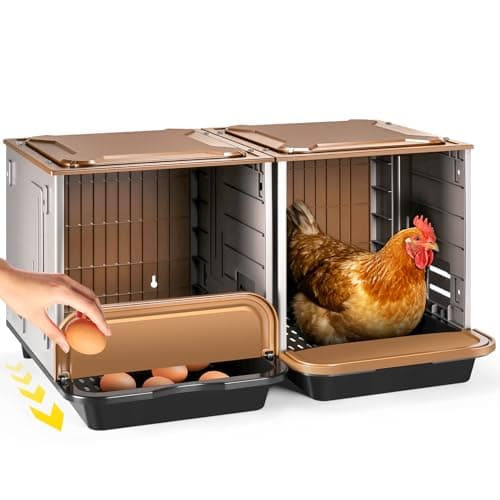
Nesting Boxes
How many nesting boxes do chickens need?
The published box-count rule with a table by flock size, and why adding more boxes does not stop the queue.
Start Here
How many chickens should I get?
Flock sizing by household, yard and coop, with the space figures and the honest note about flocks growing.
Chicken Coops
The best chicken coops for 6 chickens
Six hens is the most over-claimed size in the category. These coops genuinely clear 12 sq ft.