Best Overall Feeder
The best chicken feeders
Our main feeder ranking: treadle feeders, port feeders and bucket conversions, judged on waste and rodents.
Most of what looks like appetite is waste. Feeder design is how you stop it, and it is the one upgrade that pays for itself.
Chickens & Coops earns a commission when you buy through our links, at no extra cost to you. Prices come from Amazon and change; the date beside every price is when we last verified it. Full disclosure.
Ranked on the specifications below. Prices are live and dated; where no live price resolves, the cell reads Check price.
| # | Product | Capacity | Score | Price |
|---|---|---|---|---|
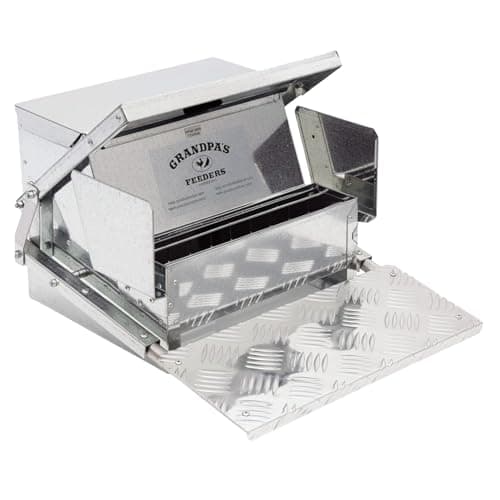
| Rank 1 | Grandpa's Feeders Automatic Chicken Feeder, 20 lb Stopping rats and wild birds outright | 20 lb | 8.2 | $219.95on Amazon |
| Rank 2 | 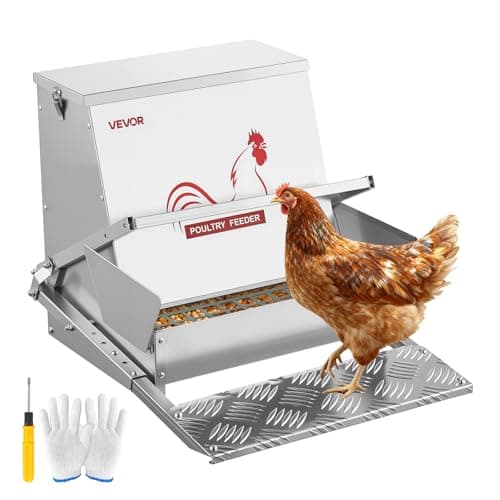 VEVOR Automatic Treadle Feeder, 40 lb Treadle performance at a third of the price | 40 lb | 9.0 | $94.90on Amazon |
| Rank 3 | 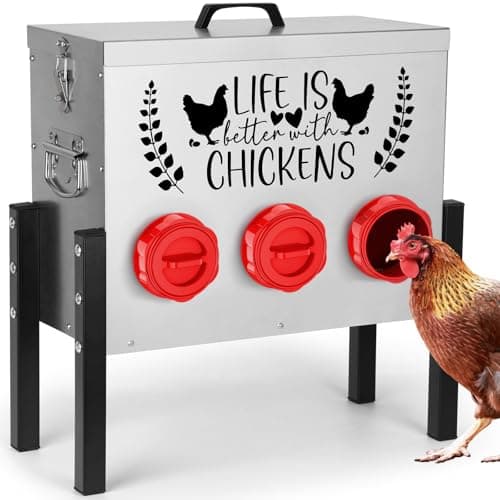 Tgeyd 30 lb Feeder with 6 No-Waste Ports Thirty pounds of feed in a lockable metal hopper | 30 lb | 8.2 | $29.98on Amazon |
| Rank 4 | 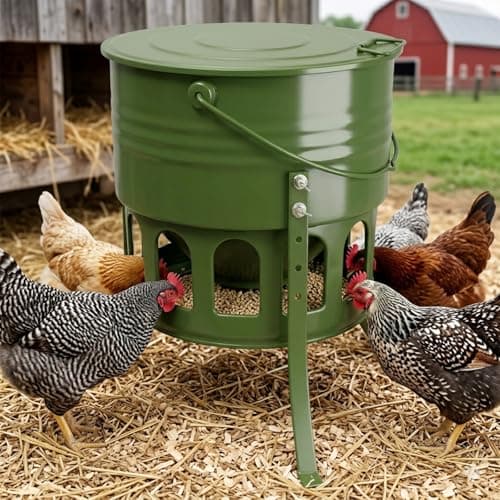 Metal No-Waste Feeder, 20 lb with 12 Ports and Tripod Stand Twelve ports for a big flock at feeding time | 20 lb | 7.2 | $53.99on Amazon |
| Rank 5 | 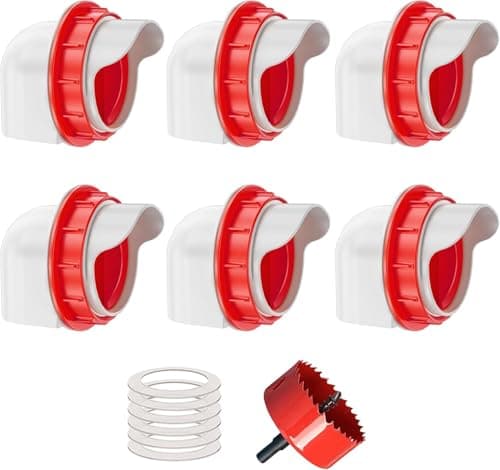 DIY No-Waste Feeder Port Kit, 6 Ports Converting a bucket you already own | Depends on the bucket used | 7.0 | $19.99on Amazon |
#ad Prices come from Amazon and change. How this site is funded. Scores are our own published rubric, not a lab test — see how we pick.
Start with the figure, because everything else follows from it. Extension's guidance on feeding chickens for egg production puts a mature hen at roughly 0.25 lb of feed per day — about 3 lb a week for a 6 lb bird. Intake rises in cold weather, because birds burn energy staying warm, and falls in heat.
That means six hens should go through about 1.5 lb a day, or roughly eleven 50 lb bags a year. If your feed is disappearing substantially faster than that and the birds are not gaining weight, you are not feeding chickens — you are feeding waste, rodents, or both. The arithmetic is the most useful diagnostic in this whole section.
Hens do not eat tidily. Given an open trough, a hen turns her head sideways and sweeps, looking for the bits she prefers — the maize in a mixed ration, the larger particles in a crumble. The rest goes over the edge, where it gets trodden in, rained on and eaten by rodents. That behavior is called billing out, it is completely normal foraging, and it is what feeder design exists to prevent.
There are exactly three mechanisms that work, and anything without one of them is marketing:
This is where the three mechanisms separate. Ports and hanging pans reduce waste; only a closed lid excludes rodents. And rodents are not a side issue: nobody gets rats because they keep chickens, they get rats because an open hopper of grain is available every night in a sheltered spot.
A treadle feeder is the only design in the category that constitutes a physical barrier. A rat is too light to open the lid and a wild bird cannot work the mechanism. That has a biosecurity dimension too — USDA's Defend the Flock guidance notes that wild birds can introduce disease to domestic flocks, so a feeder they cannot share is a disease measure, not only an economy.
| Flock size | Feed per week | Sensible hopper |
|---|---|---|
| 2-3 hens | 3.5-5 lb | 12 lb |
| 4-6 hens | 7-10.5 lb | 20-25 lb |
| 8-10 hens | 14-17.5 lb | 30-40 lb |
| 20 hens | 35 lb | 40 lb, refilled weekly |
A complete layer feed at around 16% protein provides everything a laying hen needs. Alongside it, two minerals go in their own dishes, free-choice, and the difference between them is the most common confusion in backyard feeding:
Offered free-choice, each works as self-regulation: the hen laying hardest takes the most calcium, and the one eating the most forage takes the most grit. Mixing either into the feed removes that. The full explanation.
Pellets for a flock of large hens: less dust, far less billed-out waste, and — the underrated reason — a hen cannot pick through them. In a crumble or mixed grain she will select what she likes and leave the rest, which unbalances the ration she actually eats. Every pellet contains the complete formula. Crumble suits bantams, young pullets and mixed-age flocks that find pellets awkward.
11 pages in this section. Roundup tiles carry the live price and a buy link for their top pick.
Best Overall Feeder
Our main feeder ranking: treadle feeders, port feeders and bucket conversions, judged on waste and rodents.
Best Automatic Feeder
The word "automatic" hides two different products. This page separates them and ranks both.
Best No-Waste Feeder
The port and treadle designs that stop billed-out waste, including the bucket kit that costs almost nothing.
Best Treadle Feeder
Every treadle feeder worth considering, from a 12 lb model for three hens to a 40 lb hopper for a big flock.
Best Rat-Proof Feeder
The feeders that genuinely exclude rodents — all treadle, because nothing else does — plus what else has to change.
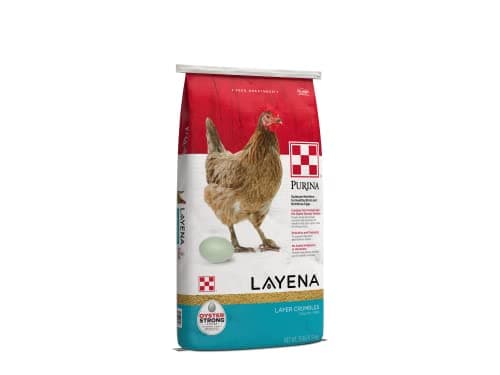
Best Chicken Feed
Complete layer feed options plus the grit and oyster shell that go alongside, and why those two are not the same thing.
Comparison
The automatic-feeder fork: a weight-operated lid versus a clock. For layers, one answer is clearly right.
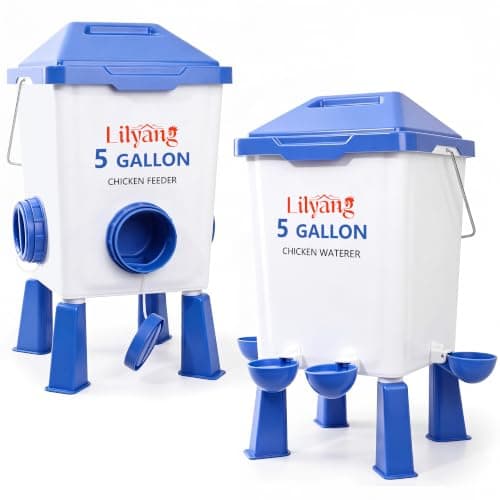
Comparison
When a matched feeder-and-waterer set is the right purchase, and when to buy each half on its merits.
Guide
The published figure, a table by flock size, and what makes real-world consumption differ from it.
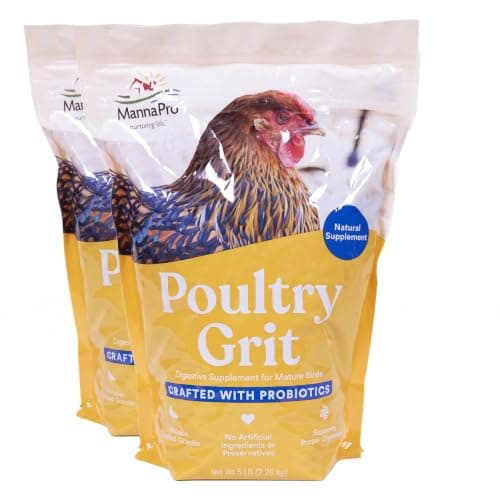
Guide
Grit versus oyster shell, properly explained: who needs which, when, and why they go in separate dishes.
Guide
Five changes in order of effectiveness, why poison is the wrong first move, and the feeders that end the problem.