Best Overall Nest Box
The best nesting boxes for chickens
Our main nest box ranking, from a single plastic box to an eight-hole roll-away bank, with the box-count rule.
A 12-inch cube, mounted below the roost, in the darkest corner. The details after that decide whether hens use it at all.
Chickens & Coops earns a commission when you buy through our links, at no extra cost to you. Prices come from Amazon and change; the date beside every price is when we last verified it. Full disclosure.
Ranked on the specifications below. Prices are live and dated; where no live price resolves, the cell reads Check price.
| # | Product | Compartments | Score | Price |
|---|---|---|---|---|
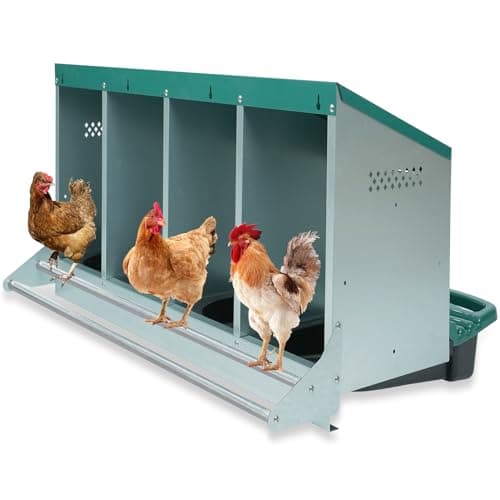
| Rank 1 | 4-Hole Heavy Duty Metal Roll-Away Nesting Box Clean eggs from sixteen hens | Not published | 8.2 | $119.99on Amazon |
| Rank 2 | 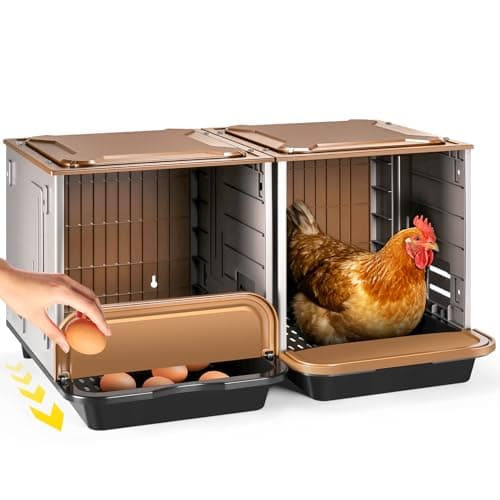 2-Compartment Nesting Box with Egg Collection Two boxes and a collection tray for eight hens | 2 | 7.6 | $45.99on Amazon |
| Rank 3 | 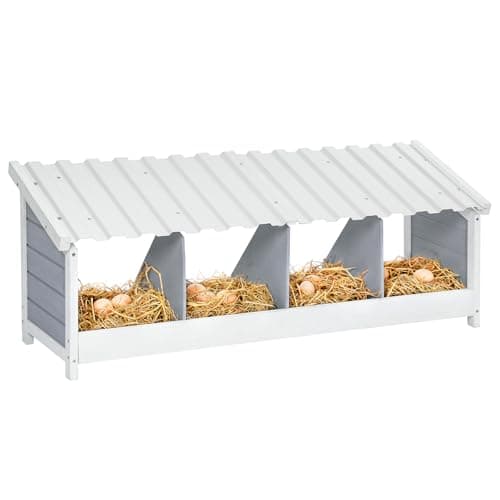 PETSFIT 4-Hole Nesting Box with PVC Waterproof Roof Boxes mounted on the outside of a coop | Not published | 8.2 | $69.06on Amazon |
| Rank 4 | 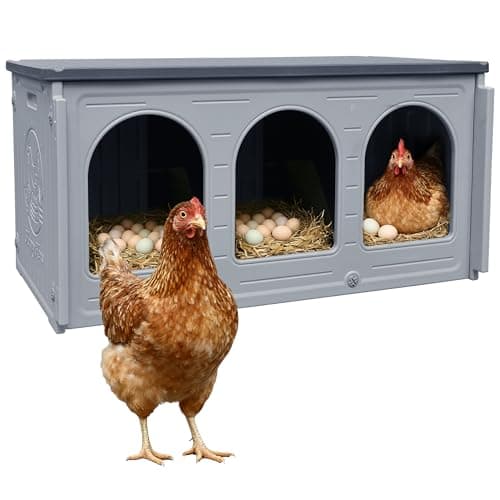 Rockever Plastic Nesting Boxes for Chickens Plastic boxes you can hose out | Not published | 7.4 | $129.99on Amazon |
| Rank 5 | 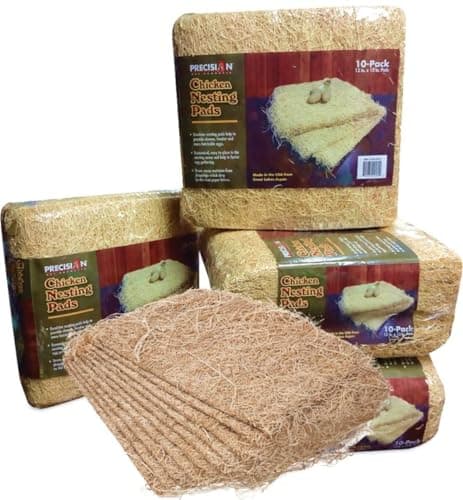 Precision Pet Chicken Nesting Pads, 13x13in, 10-Pack The standard nest pad | Not published | 8.3 | $24.99on Amazon |
#ad Prices come from Amazon and change. How this site is funded. Scores are our own published rubric, not a lab test — see how we pick.
Penn State Extension gives the box count: two nests for the first four hens, then one more nest for every four additional hens. That is slightly more generous than the folk rule of one box per four birds that circulates online, and it is the figure used throughout this site.
| Flock size | Boxes | Box size (standard hens) | Height |
|---|---|---|---|
| 2-4 hens | 2 | 12 x 12 x 12 in | 18-24 in, below the roost |
| 5-8 hens | 3 | 12 x 12 x 12 in | 18-24 in, below the roost |
| 9-12 hens | 4 | 12 x 12 x 12 in | 18-24 in, below the roost |
| 17-20 hens | 6 | 12 x 12 x 12 in | 18-24 in, below the roost |
Provide four immaculate boxes for six hens and you will find all six using one of them, sometimes two at a time, while the others sit empty. This surprises every new keeper and it is completely normal — a nest that smells and looks used signals a safe place to lay.
So the purpose of the box count is not to end the queue. It is to ensure that when a hen genuinely needs a nest and the favorite is occupied, there is somewhere acceptable to go. Adding a fifth box to four will not change the queue; it will give you another surface to clean and another place for mites to live.
Hens sleep in the highest place available. If the nest boxes sit above the roost, they will roost in the boxes — which means the boxes are fouled every night and the eggs are laid in soiled bedding. This is the most common nest box mistake and it is entirely a mounting problem.
The main decision in this section. A roll-away box has a gently sloped floor, so the egg rolls out of the hen's reach into a covered tray within seconds of being laid. A standard box keeps the egg where it was laid until you collect it.
Roll-away is the single biggest upgrade available for egg quality, for three reasons: the egg cannot be stood on by a hen with muddy feet, it cannot be broken by another hen shuffling into the nest, and — the important one — it cannot be tasted. Egg eating almost always starts with an accidentally broken egg, and once learned the habit is very hard to stop. A roll-away box removes the opportunity entirely.
The one hard incompatibility is broodiness: a hen cannot sit on eggs she cannot reach. If you want hens to hatch, keep at least one standard box. The full comparison.
Nest box material matters more than coop material, for a specific reason: a laying hen sits in a box for roughly an hour at a time, every day, with her skin against the surface — and red mite lives in the structure rather than on the bird, breeding in cracks, joints and the end grain of timber.
A molded plastic or metal box has none of those. A wooden one has dozens. Keepers who have had an infestation almost always replace nest boxes first, and it is the one component in a wooden coop most worth swapping out even if you keep everything else. A broken egg also soaks into timber grain, which smells, attracts flies and teaches egg eating.
An excelsior or aspen pad is the best general answer: it cushions the egg at the moment of laying, springs back under a hen instead of compacting flat, and stays where you put it — which loose shavings do not. 13 x 13 inches is the de facto standard size because most boxes are built around it. In a roll-away box, use a thin pad only; loose bedding collects at the low end and blocks the roll.
9 pages in this section. Roundup tiles carry the live price and a buy link for their top pick.
Best Overall Nest Box
Our main nest box ranking, from a single plastic box to an eight-hole roll-away bank, with the box-count rule.
Best Roll-Away Box
Roll-away banks from two to eight holes, ranked on build and hole count, with the slope and broody caveats.
Best Nest Pad
Excelsior, aspen and washable nest pads compared on cushioning, fit and running cost, plus the honest view on nesting herbs.
Comparison
The roll-away decision: when the premium is clearly worth it and when a standard box is fine.
Comparison
Why nest box material matters more than coop material, with the mite argument spelled out and picks for both answers.
Guide
Box dimensions by breed size, mounting height, and the design details that make a box get used.
Guide
The published box-count rule with a table by flock size, and why adding more boxes does not stop the queue.
Best Nest Material
Excelsior, shavings, straw and washable turf compared on cushioning, cleanliness and mite harborage.
Guide
A diagnostic for a stopped flock: eight causes in order of likelihood, with what actually fixes each one.