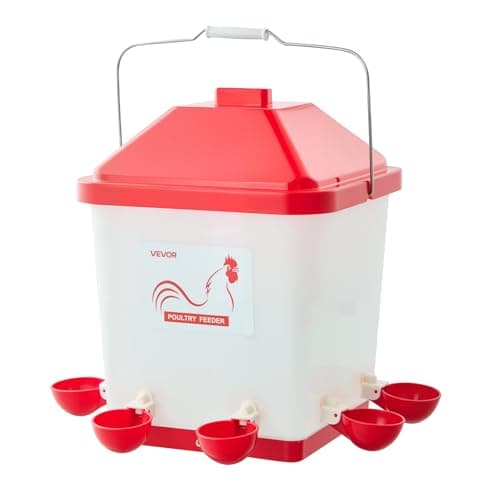
Best Overall Waterer
The best chicken waterers
Our main waterer ranking: open founts, cup systems and nipple kits, judged on cleanliness as much as capacity.
Water is the one thing a flock cannot go a day without. These are two separate problems, and one product rarely solves both.
Chickens & Coops earns a commission when you buy through our links, at no extra cost to you. Prices come from Amazon and change; the date beside every price is when we last verified it. Full disclosure.
Ranked on the specifications below. Prices are live and dated; where no live price resolves, the cell reads Check price.
| # | Product | Capacity | Score | Price |
|---|---|---|---|---|
| Rank 1 | VEVOR 5 Gallon Automatic Waterer with 6 Cups Six automatic cups on one 5-gallon reservoir | 5 gallon | 7.2 | $38.90on Amazon |
| Rank 2 | 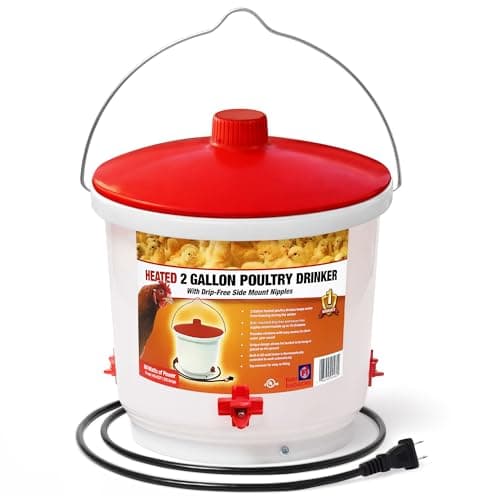 Farm Innovators HB-60P Heated Poultry Waterer, 2 Gallon 60W A purpose-built heated waterer that just works | 2 gallon | 7.2 | $42.99on Amazon |
| Rank 3 | 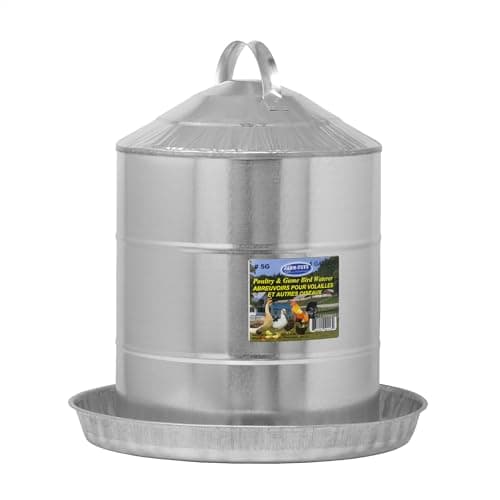 FARM-TUFF Galvanized Poultry Fountain, 5 Gallon A gravity waterer that lasts a decade | 5 gallon | 6.6 | $56.16on Amazon |
| Rank 4 | 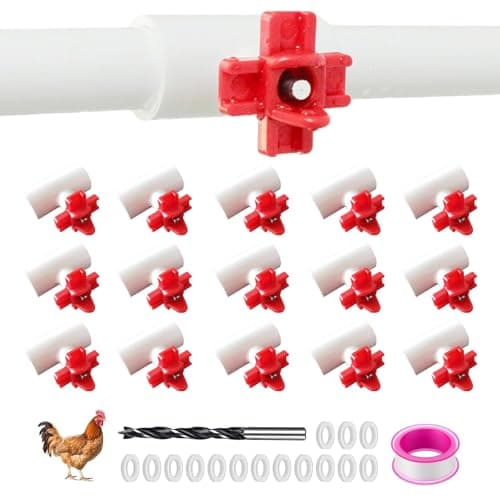 Horizontal Chicken Nipple Kit, 15-Pack with PVC Tee Fittings A DIY nipple system along a run wall | Not published | 6.8 | $16.99on Amazon |
| Rank 5 | 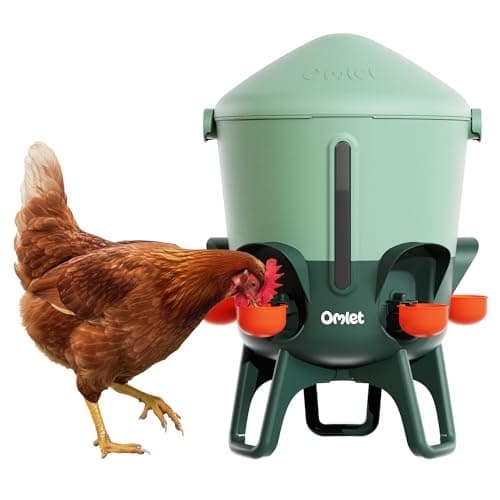 Omlet Insulated Chicken Waterer, 3 Gallon Slowing freezing without any electricity | 3 gallon | 7.0 | $109.99on Amazon |
#ad Prices come from Amazon and change. How this site is funded. Scores are our own published rubric, not a lab test — see how we pick.
University of Minnesota Extension puts a hen at about 6.4 fl oz of water a day under normal conditions, roughly doubling in warm weather, with the worked example that ten hens need about half a gallon in cool weather and about a gallon when it is hot.
A useful rule of thumb sits alongside that: poultry drink roughly twice as much water as they eat by weight. The practical value of knowing both is diagnostic — if feed intake looks normal and water intake has dropped sharply, something is wrong with the water rather than the birds.
And the reason this matters more than feed: laying stops almost immediately if water runs short, faster than it responds to anything else. An egg is about three-quarters water. Feed can be managed; water cannot be rationed.
An open waterer in summer goes from clean to green in about four days, for three reasons. Light grows algae, which is why a translucent fount in the sun is the worst case. Debris — bedding kicked in by scratching, droppings from a bird perched above, feathers. And biofilm, an invisible slick bacterial film that forms on the inside of any water vessel within days and cannot be rinsed off, only scrubbed.
The first two are solved by design: a sealed reservoir feeding nipples or cups removes them almost entirely. The third is solved only by a brush, weekly, which is why even a nipple system needs cleaning.
A hen that cannot drink stops laying within a day and is at genuine risk within two, and a frozen waterer stays frozen for as long as the weather lasts. There are two reliable answers — a thermostatted heated waterer or heated base, or swapping two waterers morning and evening — and a number of methods that buy hours without solving it.
The things that do not work are worth naming, because they circulate widely: ping pong balls (no wind in a sheltered run, and ice forms around them), salt or sugar (negligible at safe concentrations, harmful at useful ones), and glycerine or antifreeze of any kind (toxic — never). Nor can hens get adequate water from snow; melting it costs them body heat.
| Open gravity fount | Cup system | Nipple system | |
|---|---|---|---|
| Hens learn it | Immediately | Immediately | A few days |
| Water exposed | Yes, a trough | A small cup | None |
| Bedding gets in | Readily | Sometimes | Never |
| Algae | Fast in sun | Slower | Reservoir only |
| Drips into bedding | Splashing | Occasionally | No, if horizontal |
| Suits chicks | Only a chick fount | Yes | Poorly |
| Freeze resistance | Best of the three | Poor | Worst |
| Heated versions | Widely available | Rare | Rare |
The instinct is to buy the biggest capacity available so you refill it less often. Resist it: standing water grows biofilm within days whatever the volume, so a reservoir holding three weeks of water for two hens is not convenience, it is a culture vessel. Buy a capacity your flock turns over in about a week at hot-weather consumption, and rinse it weekly.
10 pages in this section. Roundup tiles carry the live price and a buy link for their top pick.
Best Overall Waterer
Our main waterer ranking: open founts, cup systems and nipple kits, judged on cleanliness as much as capacity.
Best Heated Waterer
Heated drinkers and heated bases, ranked on published wattage and thermostat control — the two figures that matter.
Top pick: Farm Innovators HB-60P Heated Poultry Waterer, 2 Gallon 60W
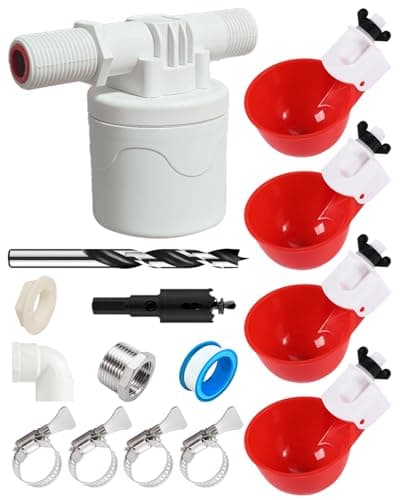
Best Automatic Waterer
Self-filling and self-dispensing waterers, with the float-valve caution that nobody mentions until it floods.
Top pick: Psarnuk DIY Automatic Waterer Kit, 4 Cups with Float Valve
Best Nipple Waterer
Horizontal nipple kits: the cleanest water on the site, the cheapest parts, and the honest winter caveat.
Top pick: Horizontal Chicken Nipple Kit, 15-Pack with PVC Tee Fittings
Comparison
The sealed-versus-open watering decision, with the cases where each one is clearly right.
Top pick: Horizontal Chicken Nipple Kit, 15-Pack with PVC Tee Fittings
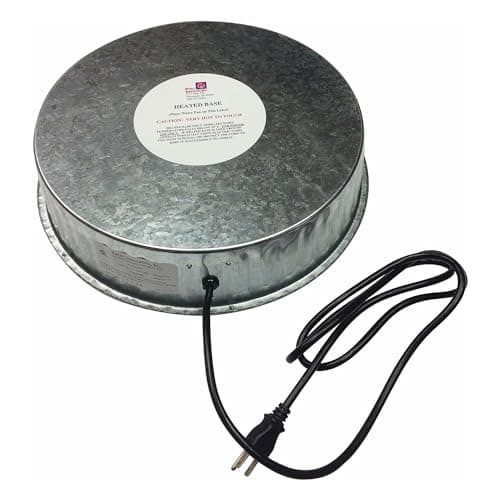
Comparison
Base or integrated drinker: the material question, the wattage question, and which is cheaper overall.
Top pick: Farm Innovators HP-125 Heated Base for Metal Founts, 125W
Guide
Every method for keeping water liquid in winter, honestly ranked — including the four that do not work.
Top pick: Farm Innovators HB-60P Heated Poultry Waterer, 2 Gallon 60W
Guide
The honest options when there is no power at the coop, ranked, with a clear statement of what none of them do.
Best for Clean Water
The three causes of dirty chicken water and what actually fixes each — including the one you cannot buy your way out of.
Top pick: Horizontal Chicken Nipple Kit, 15-Pack with PVC Tee Fittings
Guide
The published water-intake figures, a table by flock size, and why hot weather is the number that matters.