Hatching & Brooding
Incubator temperature and humidity for chicken eggs
Two numbers, three weeks. Here they are, with where they come from and what to do when the machine will not hold them.
Chickens & Coops earns a commission when you buy through our links, at no extra cost to you. Prices come from Amazon and change; the date beside every price is when we last verified it. Full disclosure.
Quick picks
| # | Product | Type | Score | Price |
|---|---|---|---|---|
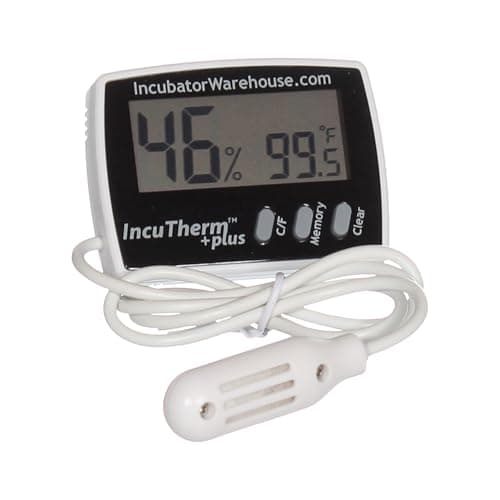
| Rank 1 | IncuTherm Plus Digital Thermometer and Hygrometer Checking what your incubator is actually doing | Digital thermometer and hygrometer | 9.0 | $28.99on Amazon |
| Rank 2 | 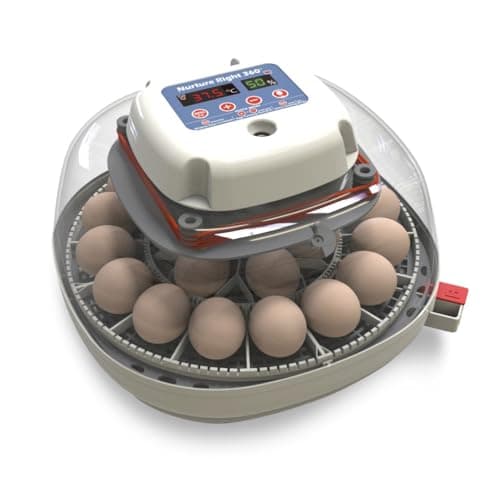 Harris Farms Nurture Right 360 Incubator, 22 Eggs The best first incubator for most people | Not published | 8.2 | $124.99on Amazon |
| Rank 3 | 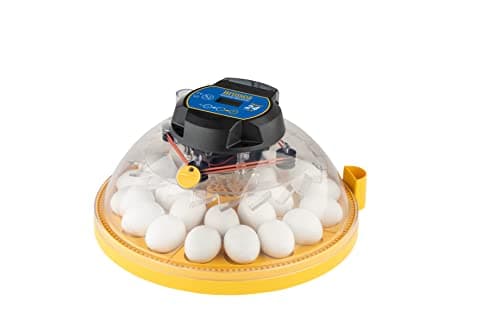 Brinsea Maxi 24 EX, 24 Eggs Serious hatching with automatic humidity | Not published | 8.2 | $340.45on Amazon |
#ad Prices come from Amazon and change. How this site is funded. Scores are our own published rubric, not a lab test — see how we pick.
Two numbers decide a hatch, and the published figures are not controversial. What is harder is holding them, and knowing what to change when you are not.
The figures
| Stage | Temperature (forced air) | Humidity | Turning |
|---|---|---|---|
| Days 1-18 | 99.5 F (acceptable 99-101 F) | 55-60% | At least 3 times a day, or automatic |
| Days 18-21 (lockdown) | 99.5 F | 65-70% | Stop turning |
| Hatch | 99.5 F | 65-70% | Do not open the incubator |
Where they come from
NC State Extension and University of Nebraska-Lincoln Extension both give a constant 99.5 F for forced-air incubators, with an acceptable range of 99-101 F and an absolute ceiling of 102 F. Humidity is 55-60% for days 1-18 and 65-70% for days 18-21. Utah State University Extension gives the same parameters for 4-H hatching projects.
Temperature: what goes wrong
The display is lying
This is the first thing to rule out, and on budget machines it is frequently the answer. Put an incubator-grade thermometer at egg level, run empty for 24 hours, and compare. If they disagree, believe the separate instrument.
The room is moving the incubator
Cheap incubators have thin walls and little thermal mass, so a cold night or an afternoon of sun through a window moves them. A stable interior room, out of sun and away from drafts, fixes more temperature problems than any adjustment to the thermostat.
Chasing the dip after opening
Opening the lid drops the temperature. It recovers. Turning the thermostat up to speed that recovery overshoots and cooks the eggs. Open it, close it, wait.
Too hot is worse than too cool
Slightly cool extends incubation by a day or two. Above 102 F causes embryo deaths and deformities. If you have to err, err cool.
Humidity: the harder number
Humidity is where most first hatches go wrong, and the reason is that it is less intuitive. Two rules make it manageable:
- Surface area, not depth. Adding water to a deeper channel does almost nothing. Humidity depends on the area of water exposed to the air. To raise it, use a wider vessel or add a damp sponge; to lower it, use a narrower one.
- Watch the air cell, not just the gauge. Candle at day 7 and day 14 and look at the air cell at the blunt end. It should be growing steadily as the egg loses moisture. Too small means humidity is too high; too large means too low. This is a more reliable signal than a cheap hygrometer.
Troubleshooting
| What you see | Likely cause | What to do |
|---|---|---|
| Temperature swings with the room | Thin-walled machine in an unstable place | Move to a stable interior room; add thermal mass around it |
| Display and thermometer disagree | Inaccurate built-in sensor | Trust the separate instrument; recalibrate the setpoint |
| Humidity will not rise | Too little water surface area | Wider vessel, or add a damp sponge |
| Humidity will not fall | Too much surface area, or a humid room | Narrower vessel; increase ventilation slightly |
| Air cell too small at day 14 | Humidity too high all along | Reduce water surface area |
| Air cell too large at day 14 | Humidity too low all along | Increase water surface area |
| Chicks pip but cannot get out | Humidity too low at lockdown | 65-70% from day 18 and keep the lid shut |
| Early hatch, small weak chicks | Running too warm | Verify with a separate thermometer; aim 99.5 F |
| Late hatch past day 22 | Running slightly cool | Verify; give them an extra day or two |
Still-air machines are different
In a still-air incubator the air stratifies, so the target temperature is higher and is measured at the top of the eggs. Follow your manufacturer's figure and their stated measurement height exactly; a thermometer on the floor of a still-air incubator reads low and leads people to overheat the eggs. Full comparison.
What makes this manageable
The thermometer that tells you the truth, and two machines whose control is good enough to act on it.
#1 · Checking what your incubator is actually doing
#ad How we are funded · Price as of October 5, 2026
IncuTherm Plus Digital Thermometer and Hygrometer
IncuThermA thermometer and hygrometer built for incubators. The single highest-value accessory in hatching: budget incubator displays can be out by several degrees, and a few degrees decides a hatch.
| Type | Digital thermometer and hygrometer |
|---|---|
| Designed for | Egg incubators |
| Accuracy | Not published by manufacturer |
Specifications per Manufacturer figures as published on the Amazon product listing, as published at the date above.
What it does well
- Lets you verify the incubator's own display instead of trusting it
- Reads humidity as well as temperature — both matter and both drift
- Purpose-built for incubator ranges rather than room comfort ranges
Where it falls short
- Stated accuracy is not published
- One more probe cable through the incubator's vent
- An extra purchase on top of the machine
Our rubric
- Fit for purpose
- 10.0
- Mess and waste
- 9.0
- Quality
- 9.0
- Value
- 8.0
#2 · The best first incubator for most people
Harris Farms Nurture Right 360 Incubator, 22 Eggs
Harris Farms22 eggs, an automatic turner and a 360-degree view, from an established poultry-equipment brand. It sits exactly where a first incubator should: enough capacity to be worth running, simple enough to get right.
| Capacity | 22 eggs |
|---|---|
| Turning | Automatic turner |
| Viewing | 360-degree window |
| Humidity control | Not published by manufacturer |
| Candler | Not published by manufacturer |
Specifications per Manufacturer figures as published on the Amazon product listing, as published at the date above.
What it does well
- 22 eggs is a realistic backyard hatch — enough that a 60% hatch rate still gives you a flock
- Automatic turning removes the three-times-a-day job that sinks most first hatches
- 360-degree viewing means you can watch without lifting the lid and dumping the humidity
- Made by a poultry brand with a long track record rather than a marketplace label
Where it falls short
- Humidity control detail is not published; expect to top water channels manually
- No candler stated as included
- Costs more than the generic 24-egg incubators
Our rubric
- Temperature stability
- 9.0
- Humidity control
- 7.0
- Capacity
- 8.0
- Beginner friendliness
- 10.0
- Value
- 7.0
#3 · Serious hatching with automatic humidity
Brinsea Maxi 24 EX, 24 Eggs
Brinsea24 eggs with automatic turning and automatic humidity control. The humidity automation is what separates it from everything cheaper: no topping up water channels, no guessing.
| Capacity | 24 eggs |
|---|---|
| Turning | Automatic |
| Humidity control | Automatic |
| Brand class | Specialist incubator manufacturer |
Specifications per Brinsea published specifications, as published at the date above.
What it does well
- Automatic humidity control removes the biggest variable in a hatch after temperature
- 24 eggs is a real batch at full automation
- Built and supported as laboratory-grade equipment, not a consumer gadget
Where it falls short
- Among the most expensive incubators a backyard keeper will consider
- Overkill for one hatch a year
- Still needs a separate brooder once the chicks are dry
Our rubric
- Temperature stability
- 10.0
- Humidity control
- 10.0
- Capacity
- 8.0
- Beginner friendliness
- 9.0
- Value
- 4.0
Frequently asked questions
What temperature and humidity for chicken eggs?
How do I raise humidity in an incubator?
Is it worse to run too hot or too cool?
How can I tell if humidity has been right?
Why did my chicks pip and then die?
Sources
Read next
Hatching & Brooding
Incubating chicken eggs: a day-by-day schedule
The full 21-day schedule with the published temperature and humidity figures, plus the equipment each stage needs.
Hatching & Brooding
Still air vs forced air incubators
Why the fan matters, where to put the thermometer in each type, and which to buy for a backyard hatch.
Hatching & Brooding
The best egg incubators
Our main incubator ranking, from a 7-egg Brinsea to a 56-egg budget machine, judged on stability first.
Hatching & Brooding
The best egg incubators for beginners
First-hatch incubators, chosen for the features that prevent beginner mistakes: auto-turning, humidity help, a candler.
Hatching & Brooding
What baby chicks need
The complete day-one-to-week-six checklist, with the CDC hygiene rules and the week-by-week changes.