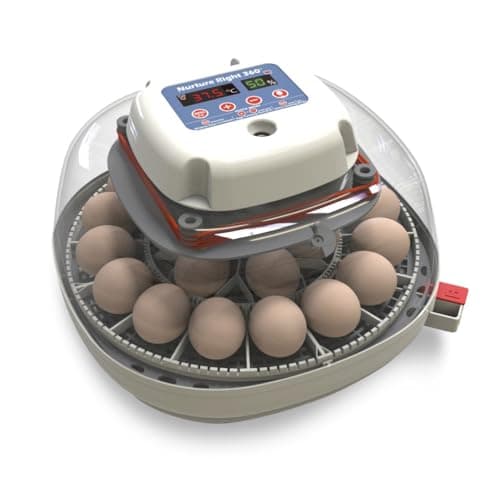
Best Overall Incubator
The best egg incubators
Our main incubator ranking, from a 7-egg Brinsea to a 56-egg budget machine, judged on stability first.
Twenty-one days at 99.5 degrees, then six weeks of brooding. The hard part is humidity, and the part people forget is the brooder.
Chickens & Coops earns a commission when you buy through our links, at no extra cost to you. Prices come from Amazon and change; the date beside every price is when we last verified it. Full disclosure.
Ranked on the specifications below. Prices are live and dated; where no live price resolves, the cell reads Check price.
| # | Product | Capacity | Score | Price |
|---|---|---|---|---|
| Rank 1 | Harris Farms Nurture Right 360 Incubator, 22 Eggs The best first incubator for most people | 22 eggs | 8.2 | $124.99on Amazon |
| Rank 2 | 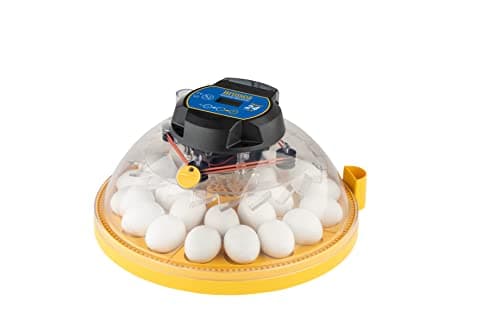 Brinsea Maxi 24 EX, 24 Eggs Serious hatching with automatic humidity | 24 eggs | 8.2 | $340.45on Amazon |
| Rank 3 | 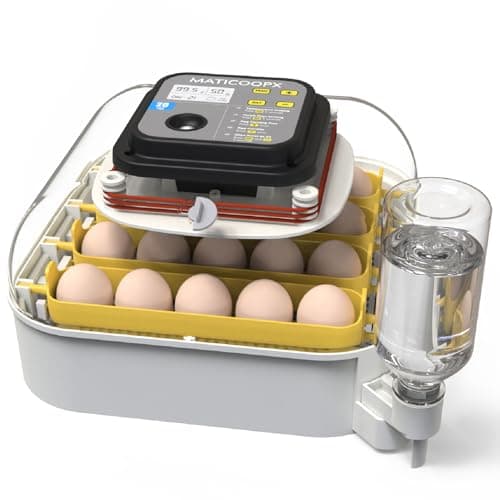 MATICOOPX 20 Egg Incubator with Candler Twenty eggs with the candler in the box | 20 eggs | 7.8 | $69.99on Amazon |
| Rank 4 | 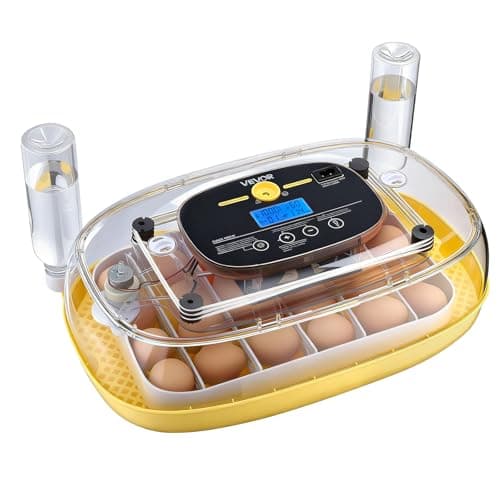 VEVOR 24 Egg Incubator with LED Candler Twenty-four eggs for the price of a bag of feed | 24 eggs | 7.6 | $42.99on Amazon |
| Rank 5 | 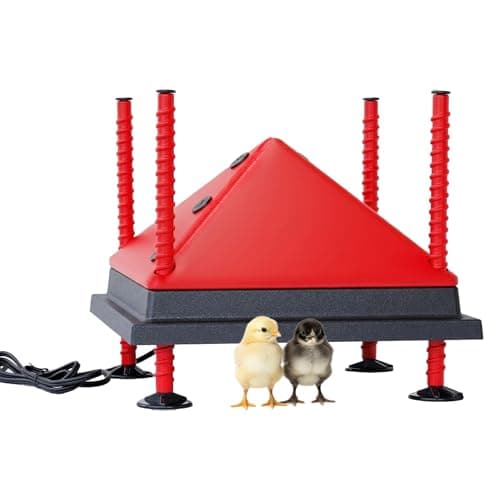 RentACoop 12x12in Adjustable Heating Plate with Anti-Roost Cone The safest brooder heat, with the roosting problem solved | Not published | 8.0 | $59.95on Amazon |
#ad Prices come from Amazon and change. How this site is funded. Scores are our own published rubric, not a lab test — see how we pick.
An incubator has one job: hold a steady temperature and a controlled humidity for twenty-one days. NC State Extension and University of Nebraska-Lincoln Extension give the figures for chicken eggs in a forced-air machine:
| Stage | Temperature | Humidity | Turning |
|---|---|---|---|
| Days 1-18 | 99.5 F (99-101 F acceptable, never above 102 F) | 55-60% | At least 3x daily, or automatic |
| Days 18-21 | 99.5 F | 65-70% | Stop turning |
Features sell incubators; stability hatches eggs. A machine that drifts two degrees in a cold room gives a poor hatch however good its feature list, and the difference between a budget incubator and a specialist one is almost entirely in control precision and in how much the room temperature moves it.
Which leads to the single most valuable piece of advice in this section: buy a separate incubator-grade thermometer and hygrometer, and verify the display before you trust it with eggs. Budget incubator displays can be out by several degrees, and several degrees is the entire margin. Run the empty machine for 24 hours with your own instrument at egg level and adjust until it holds steady.
Temperature is intuitive. Humidity is not, and it is where most first hatches go wrong. Two rules make it manageable:
Lockdown. Stop turning, raise humidity to 65-70%, close the lid and leave it closed through hatching. Opening the incubator during a hatch drops the humidity, which can shrink-wrap the membrane onto a chick mid-hatch and kill it. This is the most common well-meaning mistake in hatching, and it is worth knowing in advance because the urge to help is genuinely strong.
The limiting factor in backyard hatching is almost never incubator capacity. It is brooder space, coop space, and what happens to the cockerels. A 56-egg machine at a decent hatch rate is approaching forty birds, which needs a large brooder for six weeks and then 80 sq ft of coop floor at Penn State Extension's 2 sq ft per bird.
For most backyard keepers, a 12 to 24-egg machine is right. And about half of any hatch will be cockerels — decide what happens to them before the eggs go in, not at week twelve.
Chicks move from incubator to brooder once dry and fluffed, and they need it ready before day 21. Extension's brooding guidance covers the requirements; the equipment list is short:
CDC's backyard poultry guidance applies to chicks in full, and this is the context where it matters most because people handle chicks more and often keep them indoors. Wash hands with soap and running water, do not keep poultry in areas where food is prepared, clean equipment outdoors only, do not let children under five handle them, and do not kiss or cuddle them.
10 pages in this section. Roundup tiles carry the live price and a buy link for their top pick.
Best Overall Incubator
Our main incubator ranking, from a 7-egg Brinsea to a 56-egg budget machine, judged on stability first.
Best for a First Hatch
First-hatch incubators, chosen for the features that prevent beginner mistakes: auto-turning, humidity help, a candler.
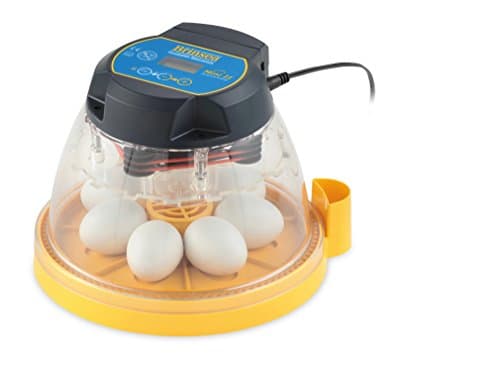
Best Small Incubator
Incubators from 4 to 20 eggs, for people who want a few chicks rather than a flock replacement.
Best Chick Brooder
Brooder heat plates, boxed kits and the chick feeder and waterer that go in — with the DIY option that works just as well.
Top pick: RentACoop 12x12in Adjustable Heating Plate with Anti-Roost Cone
Best Brooder Heat Plate
Heat plates ranked on published capacity, anti-roost design and height adjustment — the three things that differ.
Top pick: RentACoop 12x12in Adjustable Heating Plate with Anti-Roost Cone
Comparison
Why the fan matters, where to put the thermometer in each type, and which to buy for a backyard hatch.
Comparison
The brooder heat decision, with the narrow cases where a lamp is still the right tool.
Top pick: RentACoop 12x12in Adjustable Heating Plate with Anti-Roost Cone
Guide
The full 21-day schedule with the published temperature and humidity figures, plus the equipment each stage needs.
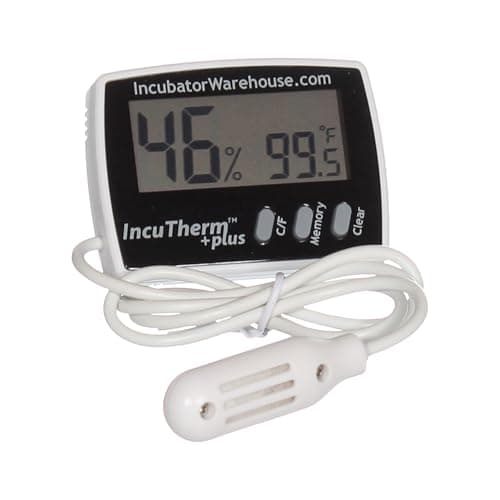
Guide
The published temperature and humidity targets, where they come from, and a troubleshooting table for missing them.
Guide
The complete day-one-to-week-six checklist, with the CDC hygiene rules and the week-by-week changes.
Top pick: RentACoop 12x12in Adjustable Heating Plate with Anti-Roost Cone