Feeders & Feed
The best chicken feed for laying hens
A complete layer feed, plus grit and oyster shell offered separately. That is the whole system, and most people get the last part wrong.
Chickens & Coops earns a commission when you buy through our links, at no extra cost to you. Prices come from Amazon and change; the date beside every price is when we last verified it. Full disclosure.
Quick picks
| # | Product | Protein | Score | Price |
|---|---|---|---|---|
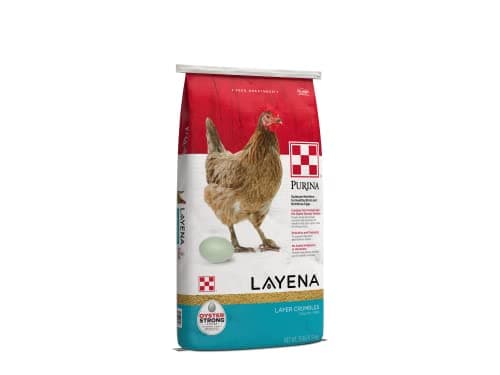
| Rank 1 | Purina Layena Layer Crumbles, 25 lb The standard bag for a six-hen flock | Not published | 8.3 | $35.98on Amazon |
| Rank 2 | 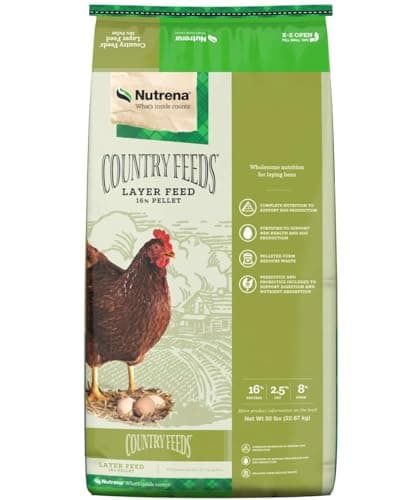 Nutrena Country Feeds 16% Layer Pellets, 50 lb The cheapest cost per pound for a bigger flock | 16% | 8.8 | $41.39on Amazon |
| Rank 3 | 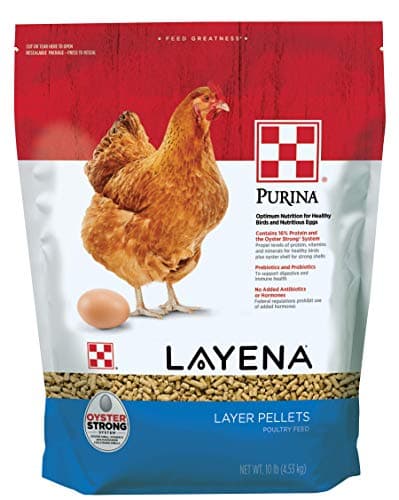 Purina Layena Layer Pellets, 10 lb A complete layer feed in a bag a small flock can finish | Not published | 8.3 | $23.99on Amazon |
| Rank 4 | 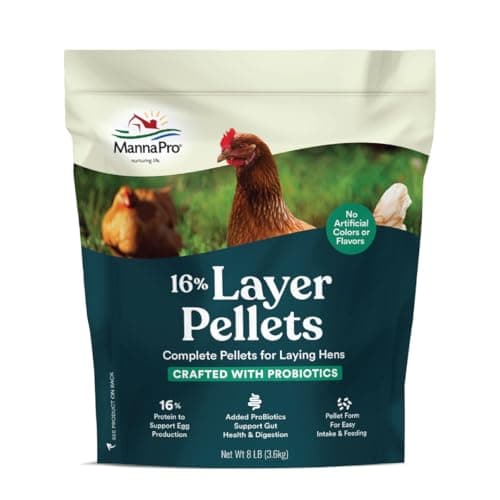 Manna Pro Layer Pellets, 16% Protein, 8 lb A published protein figure in a small bag | 16% | 7.8 | $15.20on Amazon |
| Rank 5 | 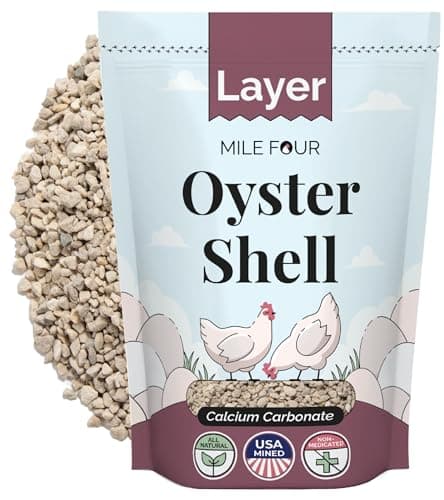 Mile Four Oyster Shell for Laying Hens, 4 lb Eggshell strength, offered free-choice | Not published | 8.8 | $19.99on Amazon |
| Rank 6 | 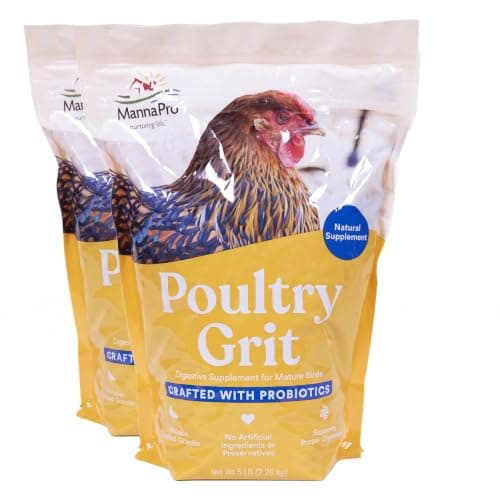 Manna Pro Poultry Grit with Probiotics, 5 lb Insoluble grit for hens eating anything but pellets | Not published | 9.0 | $19.02on Amazon |
#ad Prices come from Amazon and change. How this site is funded. Scores are our own published rubric, not a lab test — see how we pick.
Feeding laying hens is simpler than the shelf suggests. A complete layer ration provides everything they need. Alongside it you offer two minerals free-choice in their own dishes: insoluble grit, so they can digest anything that is not the complete feed, and oyster shell, so the hens laying hardest can take extra calcium. That is the system.
Layer feed: the one number to look for
16% protein is the standard target for laying hens. Some feeds state it on the bag, many do not — which is frustrating, because it is the figure you are actually shopping for. Where a listing does not state it, our spec tables say so rather than assuming.
A complete layer feed is also calcium-fortified, which is why hens fed a complete ration and nothing else still lay sound eggs. University of Georgia Extension's nutrition guidance for backyard flocks covers the full nutrient picture.
Pellets or crumble?
| Pellets | Crumble | |
|---|---|---|
| Waste | Lower — cannot be billed into dust | Higher — fines get swept out |
| Dust | Low | Higher |
| Suits bantams | Less well | Better |
| Suits young pullets | No | Yes |
| Selective feeding | Impossible — every pellet is complete | Possible, and it unbalances the ration |
The underrated argument for pellets is that a hen cannot pick through them. In a crumble or a mixed grain feed she will select the bits she likes and leave the rest, which unbalances the ration she actually eats. Every pellet contains the complete formula.
The picks
Four complete layer feeds in different bag sizes, plus the two minerals that go in separate dishes.
#1 · The standard bag for a six-hen flock
#ad How we are funded · Price as of October 5, 2026
Purina Layena Layer Crumbles, 25 lb
Purina25 lb of complete layer crumble — roughly a month for six hens. Crumble suits mixed-age flocks and bantams that find full pellets awkward.
| Type | Layer crumbles, nutritionally complete |
|---|---|
| Weight | 25 lb |
| For | Laying hens |
| Protein | Not published by manufacturer |
Specifications per Manufacturer figures as published on the Amazon product listing, as published at the date above.
What it does well
- Complete layer ration from the most widely stocked brand in the US
- Crumble is easier for bantams and smaller breeds to eat than pellets
- 25 lb is about a month for six hens — fresh all the way down the bag
Where it falls short
- Crumble generates more dust and more billed-out waste than pellets
- Protein percentage is not stated on this listing
- Needs an airtight bin once opened or it absorbs moisture
Our rubric
- Fit for purpose
- 9.0
- Mess and waste
- 7.0
- Quality
- 9.0
- Value
- 8.0
#2 · The cheapest cost per pound for a bigger flock
Nutrena Country Feeds 16% Layer Pellets, 50 lb
Nutrena50 lb of 16% layer pellets with the protein figure published. For eight or more hens this is the sensible format — provided you have a sealed bin to keep it in.
| Type | Layer pellets |
|---|---|
| Protein | 16% |
| Weight | 50 lb |
| For | Laying hens |
Specifications per Manufacturer figures as published on the Amazon product listing, as published at the date above.
What it does well
- Lowest cost per pound of any layer feed here
- 16% protein stated
- 50 lb is about six weeks for eight hens
Where it falls short
- 50 lb needs a rodent-proof metal bin, or you are feeding mice
- Heavy to move and awkward to pour
- Too much feed for a flock of three — it will stale before it is finished
Our rubric
- Fit for purpose
- 9.0
- Mess and waste
- 8.0
- Quality
- 8.0
- Value
- 10.0
#3 · A complete layer feed in a bag a small flock can finish
#ad How we are funded · Price as of October 5, 2026
Purina Layena Layer Pellets, 10 lb
PurinaA nutritionally complete layer pellet in a 10 lb bag. Pellets waste less than crumble because hens cannot bill the fines out, and 10 lb is small enough that a three-hen flock finishes it fresh.
| Type | Layer pellets, nutritionally complete |
|---|---|
| Weight | 10 lb |
| For | Laying hens |
| Protein | Not published by manufacturer |
Specifications per Manufacturer figures as published on the Amazon product listing, as published at the date above.
What it does well
- Complete feed — no supplementing needed beyond grit and oyster shell
- Pellets produce far less billed-out waste than crumble
- 10 lb is the right bag for two or three hens: finished before it stales
Where it falls short
- Protein percentage is not stated on this listing
- Cost per pound is high compared with a 25 or 50 lb bag
- Pellets are too large for pullets under laying age
Our rubric
- Fit for purpose
- 9.0
- Mess and waste
- 9.0
- Quality
- 9.0
- Value
- 6.0
#4 · A published protein figure in a small bag
#ad How we are funded · Price as of October 5, 2026
Manna Pro Layer Pellets, 16% Protein, 8 lb
Manna ProOne of the few layer feeds that states its protein level on the listing: 16%, which is the standard target for laying hens. 8 lb is a trial-size or very-small-flock bag.
| Type | Layer pellets with digestive aid |
|---|---|
| Protein | 16% |
| Weight | 8 lb |
| For | Laying hens |
Specifications per Manufacturer figures as published on the Amazon product listing, as published at the date above.
What it does well
- 16% protein stated outright — the figure you are actually shopping for
- Pellet form, so less waste than crumble
- Small bag is useful for trialling a feed change without committing 50 lb
Where it falls short
- 8 lb is under a fortnight for three hens; cost per pound is poor
- Includes a digestive aid, which is fine but is not a substitute for grit
- Small bags are not resealable
Our rubric
- Fit for purpose
- 9.0
- Mess and waste
- 8.0
- Quality
- 8.0
- Value
- 6.0
#5 · Eggshell strength, offered free-choice
#ad How we are funded · Price as of October 5, 2026
Mile Four Oyster Shell for Laying Hens, 4 lb
Mile FourCrushed oyster shell as a free-choice calcium source. Layer feed already contains calcium; a separate dish of oyster shell lets the individual hens that need more take more.
| Type | Crushed oyster shell |
|---|---|
| Weight | 4 lb |
| Function | Calcium for egg-laying hens |
| Feeding | Free-choice |
Specifications per Manufacturer figures as published on the Amazon product listing, as published at the date above.
What it does well
- Free-choice calcium is self-regulating: hens laying hardest take the most
- Directly addresses thin and soft shells
- 4 lb lasts a small flock months
Where it falls short
- Not a substitute for grit — oyster shell dissolves, so it cannot grind
- Should never be fed to chicks or non-laying pullets
- Must go in its own dish, not mixed into the feed
Our rubric
- Fit for purpose
- 10.0
- Mess and waste
- 9.0
- Quality
- 9.0
- Value
- 7.0
#6 · Insoluble grit for hens eating anything but pellets
#ad How we are funded · Price as of October 5, 2026
Manna Pro Poultry Grit with Probiotics, 5 lb
Manna ProInsoluble crushed granite — the grinding stone a hen's gizzard needs to process grass, scratch and kitchen scraps. It is not a calcium supplement and does not replace oyster shell.
| Type | Insoluble crushed granite grit |
|---|---|
| Weight | 5 lb |
| Added | Probiotics |
| Function | Gizzard grinding material |
Specifications per Manufacturer figures as published on the Amazon product listing, as published at the date above.
What it does well
- States 'insoluble crushed granite', which is exactly what grit should be
- 5 lb lasts a small flock a very long time — it is offered free-choice, not mixed in
- Essential the moment hens eat anything other than a complete pellet
Where it falls short
- Routinely confused with oyster shell; they do different jobs and you need both
- Not needed at all for birds fed only complete crumble indoors
- Offer it in a separate small dish, not mixed into feed
Our rubric
- Fit for purpose
- 10.0
- Mess and waste
- 9.0
- Quality
- 9.0
- Value
- 8.0
Grit and oyster shell are not the same thing
This is the most common confusion in backyard feeding, and worth being precise about.
| Insoluble grit | Oyster shell | |
|---|---|---|
| What it is | Crushed granite or quartzite | Crushed oyster or seashell |
| What it does | Grinds food in the gizzard | Provides calcium for eggshells |
| Dissolves? | No — that is the point | Yes — that is the point |
| Who needs it | Any bird eating grass, scratch or scraps | Laying hens only |
| Who should not have it | Birds on complete feed only do not need it | Chicks and non-laying pullets |
| How to offer it | Free-choice, separate dish | Free-choice, separate dish |
Neither should be mixed into the feed. Offered free-choice, each hen takes what she needs — a hen laying daily takes far more calcium than one in moult, and only she knows which she is.
How much, and therefore which bag size
| Flock size | Feed per day | Feed per week | 20 lb feeder lasts | 40 lb feeder lasts |
|---|---|---|---|---|
| 2 hens | 0.5 lb | 3.5 lb | about 5 weeks | about 11 weeks |
| 4 hens | 1 lb | 7 lb | about 3 weeks | about 5 weeks |
| 6 hens | 1.5 lb | 10.5 lb | about 13 days | about 4 weeks |
| 8 hens | 2 lb | 14 lb | about 10 days | about 20 days |
| 10 hens | 2.5 lb | 17.5 lb | about 8 days | about 16 days |
| 20 hens | 5 lb | 35 lb | about 4 days | about 8 days |
Treats, scratch and kitchen scraps
- Scratch grain is a treat, not a feed. It is largely maize and low in protein; fed heavily it dilutes the complete ration.
- Keep treats to a small share of intake. The complete feed is complete only if it is most of what they eat.
- Any bird eating anything other than complete feed needs grit.
- Never feed moldy food. CDC advises against bringing poultry into food preparation areas, and the reverse caution applies to what comes out: spoiled scraps are a genuine risk.
Frequently asked questions
What protein percentage should layer feed be?
Do chickens need grit if they get layer feed?
Is oyster shell the same as grit?
Should I feed pellets or crumble?
How much does a chicken eat per day?
Can chickens eat kitchen scraps?
Sources
Read next
Feeders & Feed
Grit and oyster shell: what each one actually does
Grit versus oyster shell, properly explained: who needs which, when, and why they go in separate dishes.
Feeders & Feed
How much feed does a chicken eat per day?
The published figure, a table by flock size, and what makes real-world consumption differ from it.
Feeders & Feed
The best chicken feeders
Our main feeder ranking: treadle feeders, port feeders and bucket conversions, judged on waste and rodents.
Nesting Boxes
Why have my chickens stopped laying?
A diagnostic for a stopped flock: eight causes in order of likelihood, with what actually fixes each one.
Start Here
The real cost of raising backyard chickens
A cost framework using live prices and published consumption figures, so the numbers are yours rather than ours.