Feeders & Feed
How much feed does a chicken eat per day?
About a quarter of a pound per hen, per day. Everything else on this page is what moves that number.
Chickens & Coops earns a commission when you buy through our links, at no extra cost to you. Prices come from Amazon and change; the date beside every price is when we last verified it. Full disclosure.
Quick picks
| # | Product | Weight | Score | Price |
|---|---|---|---|---|
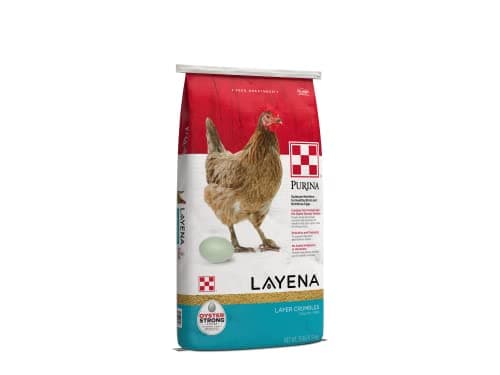
| Rank 1 | Purina Layena Layer Crumbles, 25 lb The standard bag for a six-hen flock | 25 lb | 8.3 | $35.98on Amazon |
| Rank 2 | 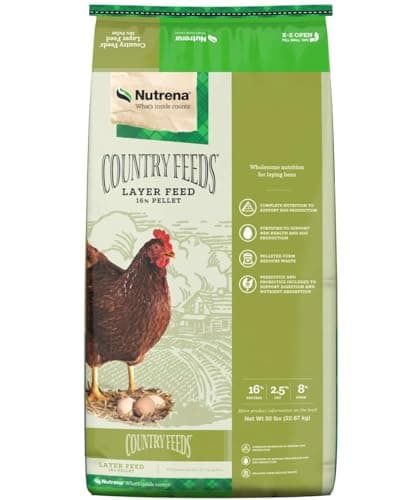 Nutrena Country Feeds 16% Layer Pellets, 50 lb The cheapest cost per pound for a bigger flock | 50 lb | 8.8 | $41.39on Amazon |
| Rank 3 | 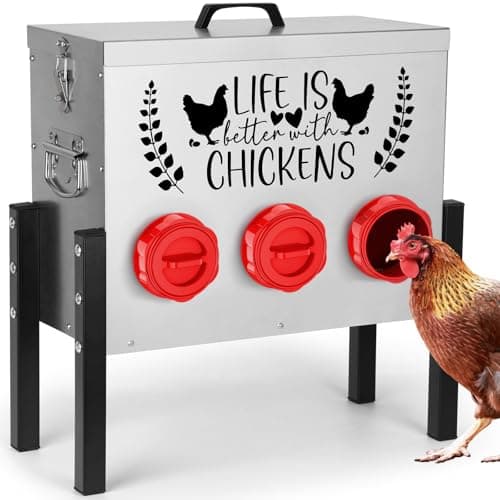 Tgeyd 30 lb Feeder with 6 No-Waste Ports Thirty pounds of feed in a lockable metal hopper | Not published | 8.2 | $29.98on Amazon |
#ad Prices come from Amazon and change. How this site is funded. Scores are our own published rubric, not a lab test — see how we pick.
A mature laying hen eats roughly 0.25 lb of feed per day — about 3 lb a week for a 6 lb bird. That figure comes from Extension's guidance on feeding chickens for egg production, and it is the number to plan feeders, bags and budgets around.
By flock size
| Flock size | Feed per day | Feed per week | 20 lb feeder lasts | 40 lb feeder lasts |
|---|---|---|---|---|
| 2 hens | 0.5 lb | 3.5 lb | about 5 weeks | about 11 weeks |
| 4 hens | 1 lb | 7 lb | about 3 weeks | about 5 weeks |
| 6 hens | 1.5 lb | 10.5 lb | about 13 days | about 4 weeks |
| 8 hens | 2 lb | 14 lb | about 10 days | about 20 days |
| 10 hens | 2.5 lb | 17.5 lb | about 8 days | about 16 days |
| 20 hens | 5 lb | 35 lb | about 4 days | about 8 days |
What changes the number
Temperature — the biggest factor
Extension guidance is explicit that environmental temperature plays an important role: feed intake falls in hot weather and rises in cold weather, because birds eat more to supply the extra energy needed to maintain body temperature. In a cold snap, expect consumption noticeably above the 0.25 lb baseline.
Bird size and breed
The 0.25 lb figure is for a standard-size hen of roughly 6 lb. A bantam eats considerably less; a heavy breed such as a Brahma or Jersey Giant eats more. Scale roughly with body weight.
Laying rate
A hen in full lay needs more energy than one in moult or winter rest. Consumption drops in autumn when laying stops, which surprises people who expect it to rise with the cold. Both effects are real and they partly cancel.
Free-ranging
Birds with access to pasture, insects and forage take less from the feeder — sometimes substantially less in summer. This is real and it is also why free-ranging birds need insoluble grit: they are eating material the complete feed does not account for.
Waste, which is not consumption
If your feed disappears much faster than 0.25 lb per hen per day, the likely explanations are waste and theft rather than appetite. An open trough lets hens bill feed onto the ground; an open feeder at night feeds rodents. Both look like consumption on the bag count.
Sizing the bag and the feeder
- Work out weekly consumption: flock size x 1.75 lb.
- Buy a bag that lasts about a month. Longer and it stales in the bag; shorter and you are shopping constantly.
- Buy a feeder that holds one to three weeks. Not more — a hopper holding two months of feed in summer is a mold risk.
- Store it in metal. A galvanized bin with a tight lid. Rodents chew plastic and paper.
Water goes with it
Feed planning without water planning is half the job. Hens drink roughly twice as much water as they eat by weight — about 6.4 fl oz each per day in cool weather, and about double in hot weather. For ten hens that is half a gallon a day in cool weather and a gallon in heat, per University of Minnesota Extension.
Sizing the purchase
Two bag sizes that match common flock sizes, and a hopper that holds the right amount for six to ten hens.
#1 · The standard bag for a six-hen flock
#ad How we are funded · Price as of October 5, 2026
Purina Layena Layer Crumbles, 25 lb
Purina25 lb of complete layer crumble — roughly a month for six hens. Crumble suits mixed-age flocks and bantams that find full pellets awkward.
| Type | Layer crumbles, nutritionally complete |
|---|---|
| Weight | 25 lb |
| For | Laying hens |
| Protein | Not published by manufacturer |
Specifications per Manufacturer figures as published on the Amazon product listing, as published at the date above.
What it does well
- Complete layer ration from the most widely stocked brand in the US
- Crumble is easier for bantams and smaller breeds to eat than pellets
- 25 lb is about a month for six hens — fresh all the way down the bag
Where it falls short
- Crumble generates more dust and more billed-out waste than pellets
- Protein percentage is not stated on this listing
- Needs an airtight bin once opened or it absorbs moisture
Our rubric
- Fit for purpose
- 9.0
- Mess and waste
- 7.0
- Quality
- 9.0
- Value
- 8.0
#2 · The cheapest cost per pound for a bigger flock
Nutrena Country Feeds 16% Layer Pellets, 50 lb
Nutrena50 lb of 16% layer pellets with the protein figure published. For eight or more hens this is the sensible format — provided you have a sealed bin to keep it in.
| Type | Layer pellets |
|---|---|
| Protein | 16% |
| Weight | 50 lb |
| For | Laying hens |
Specifications per Manufacturer figures as published on the Amazon product listing, as published at the date above.
What it does well
- Lowest cost per pound of any layer feed here
- 16% protein stated
- 50 lb is about six weeks for eight hens
Where it falls short
- 50 lb needs a rodent-proof metal bin, or you are feeding mice
- Heavy to move and awkward to pour
- Too much feed for a flock of three — it will stale before it is finished
Our rubric
- Fit for purpose
- 9.0
- Mess and waste
- 8.0
- Quality
- 8.0
- Value
- 10.0
#3 · Thirty pounds of feed in a lockable metal hopper
Tgeyd 30 lb Feeder with 6 No-Waste Ports
TgeydA heavy-duty 30 lb metal feeder with six no-waste ports, adjustable height and a locking lid. The locking lid is what lifts it above an ordinary port feeder — it keeps rain and raccoons out of the hopper.
| Capacity | 30 lb |
|---|---|
| Feeding ports | 6 |
| Lid | Locking |
| Height | Adjustable |
| Material | Heavy-duty metal |
Specifications per Manufacturer figures as published on the Amazon product listing, as published at the date above.
What it does well
- Locking lid keeps the hopper dry and stops raccoons helping themselves
- 30 lb capacity means fortnightly refills for a six-hen flock
- Adjustable height lets you set the ports correctly as pullets grow
Where it falls short
- The ports themselves are still open at hen level, so rodents can reach the feed in them
- 30 lb of feed plus a metal hopper is heavy to reposition
- Port diameter is not published
Our rubric
- Waste control
- 9.0
- Capacity
- 8.0
- Rodent resistance
- 6.0
- Weather resistance
- 9.0
- Value
- 9.0
Frequently asked questions
How much feed does one chicken eat per day?
How much feed do 6 chickens need?
Why is my chicken feed disappearing so fast?
Do chickens eat more in winter?
How much water does a chicken drink per day?
Sources
Read next
Feeders & Feed
The best chicken feed for laying hens
Complete layer feed options plus the grit and oyster shell that go alongside, and why those two are not the same thing.
Feeders & Feed
The best chicken feeders
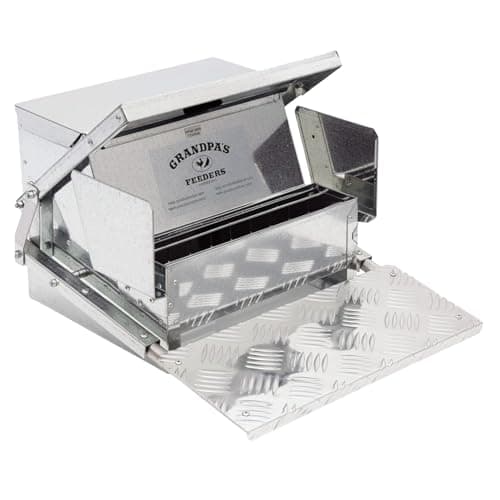
Our main feeder ranking: treadle feeders, port feeders and bucket conversions, judged on waste and rodents.
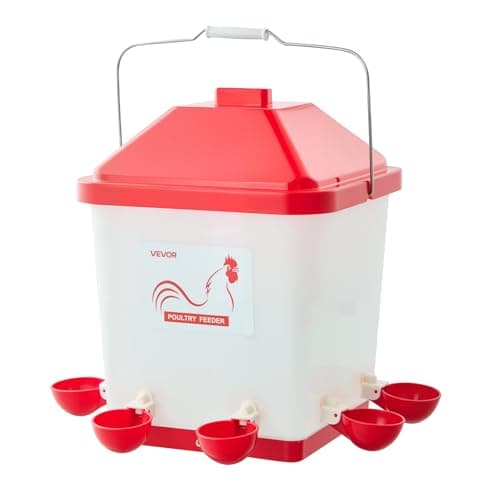
Waterers
How much water do chickens drink?
The published water-intake figures, a table by flock size, and why hot weather is the number that matters.
Feeders & Feed
How to keep rats out of chicken feed
Five changes in order of effectiveness, why poison is the wrong first move, and the feeders that end the problem.
Start Here
The real cost of raising backyard chickens
A cost framework using live prices and published consumption figures, so the numbers are yours rather than ours.