Start Here
How to introduce new chickens to a flock
Quarantine for two to four weeks, then a week of seeing each other through mesh, then add them after dark. Rushing any of the three is where it goes wrong.
Chickens & Coops earns a commission when you buy through our links, at no extra cost to you. Prices come from Amazon and change; the date beside every price is when we last verified it. Full disclosure.
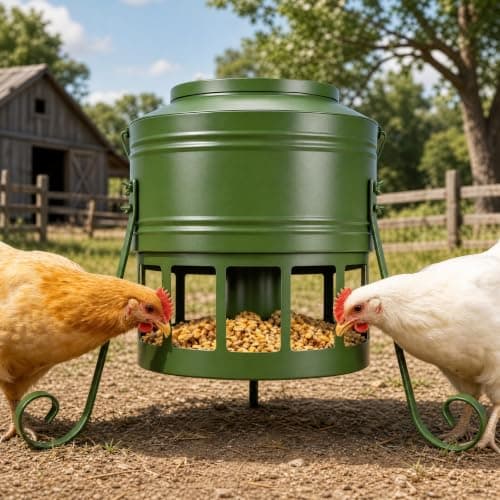
Top pick
Maansfy Metal No-Waste Feeder, 20 lb with 12 Ports
A 20 lb heavy-duty metal hopper with twelve ports and smoothed edges.
#ad How we are funded · Price as of November 8, 2026
Quick picks
| # | Product | Capacity | Score | Price |
|---|---|---|---|---|
| Rank 1 | Maansfy Metal No-Waste Feeder, 20 lb with 12 Ports Twelve ports for a big flock at feeding time | 20 lb | 9.0 | $39.99Maansfy Metal |
| Rank 2 |  Lil'Clucker Large Automatic Waterer Cups Cups large enough for chicks and full-grown hens | Not published | 8.4 | $18.99Lil'Clucker Large |
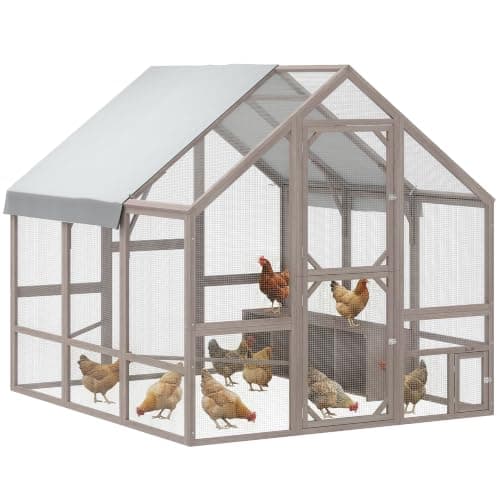
| Rank 3 | 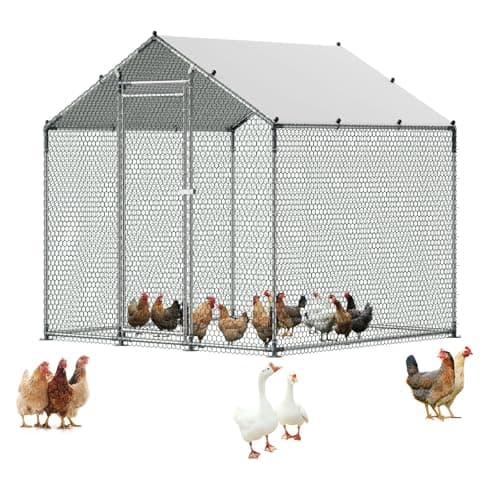 VEVOR Metal Walk-in Chicken Run, 6.56ft square A small, cheap walk-in run with a spire roof | Not published | 9.2 | $104.41VEVOR Metal Walk-in |
#ad Prices come from Amazon and change. How this site is funded. Scores are our own published rubric, not a lab test — see how we pick.
Introduce new chickens in four stages: quarantine the newcomers separately for two to four weeks, house them next to the flock behind mesh for about a week, move them onto the roost after dark, then give the combined flock extra feeding and drinking points for a fortnight. Add two or more birds at once rather than a single newcomer, and expect a genuinely rough week while the pecking order resettles.
Those stages exist for two different reasons. The quarantine is about disease. Everything after it is about social order — and the social part is the one people underestimate, because a flock defending its space is not being spiteful, it is doing exactly what a flock does.
Stage 1 — quarantine, two to four weeks
New birds go somewhere the existing flock cannot reach, share air with, or walk through the droppings of. USDA's Defend the Flock guidance covers why this matters: a newly acquired bird is the single most likely route for disease into a healthy backyard flock, and a bird can be shedding something while looking perfectly well.
- Separate housing, as far from the flock as you can manage. A spare coop, a dog crate in a shed, a sectioned-off run.
- Separate feeders and waterers, and ideally separate footwear or at least a boot scrub between the two.
- Look after the existing flock first each day, newcomers second, so you are not carrying anything the wrong way.
- Watch for clear eyes, clean vents, easy breathing, good feather condition and normal droppings. Anything that looks wrong extends the quarantine rather than ending it.
- Treat for external parasites before the birds meet. Most mite and lice infestations arrive on a new bird, and it is far easier to deal with one crate than a whole coop. Chicken mites treatment.
Stage 2 — see but do not touch, about a week
Put the newcomers where the flock can see them but not reach them: a pen inside the run, a divided run, or a small run set alongside the main one. The birds work out the beginnings of a hierarchy through mesh, where nobody can be cornered.
A week is typical. Two is better with a nervous or much smaller group. You are waiting for the point where the birds on both sides of the mesh are ignoring each other rather than posturing.
Stage 3 — add them at night
Move the newcomers onto the roost after dark, when the flock has settled. Birds wake up to find the newcomers already there, which takes the territorial edge off the first meeting. Get up early the next morning and watch the first hour: that is when you find out whether it is going to be fine.
- Normal: chasing, pecking at the head and neck, newcomers keeping to the edges and eating last. Unpleasant to watch, and it is how a pecking order forms.
- Not normal, intervene: blood drawn, a bird cornered and unable to escape, a bird kept off feed and water for hours, or ganging up by several birds on one.
- Intervene by changing the space, not by removing the bully. Pull the newcomers back behind the mesh for a few more days and try again — taking out the dominant hen just promotes the next one and resets the whole process.
Stage 4 — manage the space for a fortnight
Almost every integration problem is a space problem wearing a social costume. Crowding is what turns normal pecking-order sorting into real bullying, and Penn State Extension's housing guidance is the standard to measure against: 2 sq ft of coop floor and 10 sq ft of run for a large chicken, 1.5 sq ft and 8 sq ft for laying hens of lighter breeds.
Do the arithmetic for the combined flock before you add anyone. If six birds becomes nine, the coop needs half again as much floor and the run needs ninety square feet rather than sixty. If it does not have it, the integration will be worse than it needs to be and the problem will not resolve when the pecking order does. Coop size per chicken has the full table.
- Add a second feeding point and a second drinking point, out of sight of the first. A newcomer at the bottom of the order will not queue at a feeder a dominant hen is standing over, and a feeder with plenty of ports means the whole flock can eat at once.
- Add visual breaks in the run — a pallet leaned against a wall, a board, a branch, a second shelter. Somewhere to get out of the line of sight of a dominant bird is worth more than extra square feet of open ground.
- Add roost length. Penn State Extension gives six inches of perch space per standard bird. New birds get pushed off the roost first.
- Do not add nest box pressure. Two nests for the first four hens, then one per four after that. How many nesting boxes.
- Expect a laying drop. New birds in the flock means a week or two of fewer eggs from everybody. That is stress, it is normal, and it resolves. Why chickens stop laying.
What helps
A feeder with enough ports that nobody has to queue, a second set of drinking points, and a small separate run for the quarantine and mesh stages.
#1 · Twelve ports for a big flock at feeding time
#ad How we are funded · Price as of November 8, 2026
Maansfy Metal No-Waste Feeder, 20 lb with 12 Ports
MaansfyA 20 lb heavy-duty metal hopper with twelve ports and smoothed edges. Twelve ports ends the feeding-time scrum outright: a dozen hens eat at once instead of the bottom birds waiting their turn at a two-port trough.
| Capacity | 20 lb |
|---|---|
| Feeding ports | 12 |
| Build | Heavy duty metal, smoothed port edges |
| Material | Metal |
| Siting | Free-standing, for coop or outdoors |
Specifications per Manufacturer figures as published on the Amazon product listing, as published at the date above.
Why we picked it
- Twelve ports means a dozen hens eat at once instead of the bottom birds waiting
- Smoothed port edges, published — the detail that stops a hen scraping her comb at a metal feeder
- Metal body resists chewing better than a plastic bucket conversion
- Free-standing, so it does not need a hanging point
Good to know — Open ports do not keep rodents out overnight
Our rubric
- Waste control
- 9.8
- Capacity
- 8.9
- Rodent resistance
- 7.5
- Weather resistance
- 8.9
- Value
- 9.8
#2 · Cups large enough for chicks and full-grown hens
#ad How we are funded · Price as of November 8, 2026
Lil'Clucker Large Automatic Waterer Cups
Lil'CluckerLarger-than-usual auto-fill cups, stated as suitable for chicks through to turkeys. Cup size matters: a tiny cup empties faster than the valve refills when a hen is really drinking.
| Type | Automatic water cups |
|---|---|
| Size | Large cup |
| Suitable for | Chicks, ducks, geese, turkeys |
| Pack size | Not published by manufacturer |
Specifications per Manufacturer figures as published on the Amazon product listing, as published at the date above.
Why we picked it
- Large cup holds enough that a thirsty hen is not waiting for the valve
- Shallow enough for chicks, which the deep nipple systems are not
- Works for mixed poultry, not just hens
Good to know — Pack size is not published on the listing
Our rubric
- Capacity
- 7.9
- Stays clean
- 8.9
- Freeze resistance
- 6.5
- Ease of refill
- 9.3
- Value
- 9.3
#3 · A small, cheap walk-in run with a spire roof
$109.90 5% off
#ad How we are funded · Price as of November 8, 2026
VEVOR Metal Walk-in Chicken Run, 6.56ft square
VEVORA 6.56-foot cube of galvanized walk-in run with a spire roof and cover. Small, inexpensive, and the pitched roof sheds rain and snow instead of pooling it like a flat cover.
| Dimensions | 6.56 x 6.56 x 6.56 ft |
|---|---|
| Floor area | About 43 sq ft |
| Roof | Spire roof with cover |
| Frame | Metal |
| Access | Walk-in |
Specifications per Manufacturer figures as published on the Amazon product listing, as published at the date above.
Why we picked it
- All dimensions published — 43 sq ft, which is four hens at a generous ten sq ft each
- Spire roof sheds water and snow rather than collecting it
- Cheapest honest route to a walk-in run
Good to know — Mesh type not specified, which usually means hexagonal netting
Our rubric
- Space per bird
- 8.9
- Predator resistance
- 8.4
- Ventilation
- 9.8
- Cleaning access
- 9.3
- Build
- 8.9
- Value
- 9.8
Things that make it harder
- Adding a single bird. One newcomer absorbs all the aggression. Two or three spread it and keep each other company.
- Mixing sizes badly. Bantams into a flock of heavy breeds, or point-of-lay pullets into a flock of mature hens, is a bigger gap than it looks. Give that combination longer behind mesh.
- Adding chicks or young pullets. They should not join an adult flock until they are close to full size, and never while they still need brooder heat. What baby chicks need covers the timeline.
- Adding a rooster. A different problem entirely, with local rules attached. How many chickens can I have in my backyard covers the ordinance side.
- Integrating in a heatwave or a hard freeze. The flock is already under load. Wait for ordinary weather.
How long until it settles
Open hostility usually subsides within a week to ten days, and the flock reads as one group within two to three weeks. What stays is a hierarchy, which is the normal state of a flock rather than a problem to solve. If you are still seeing serious aggression after three weeks, the answer is almost always space or resources — count your square feet, your feeding ports and your roost inches again before anything else.
Frequently asked questions
How do you introduce new chickens to an existing flock?
How long should you quarantine new chickens?
Why are my chickens attacking the new ones?
Should I add one chicken or several?
Can I put new chickens straight in at night?
How much space do I need for a bigger flock?
Our recommendation
If you buy one thing from this page, buy the first one. The second is here because it is the alternative worth weighing against it, not because a list needs two entries.
Top pick
Maansfy Metal No-Waste Feeder, 20 lb with 12 Ports
Twelve ports for a big flock at feeding time
#ad How we are funded · Price as of November 8, 2026
Runner-up
Lil'Clucker Large Automatic Waterer Cups
Cups large enough for chicks and full-grown hens
#ad How we are funded · Price as of November 8, 2026
Sources
Read next
Start Here
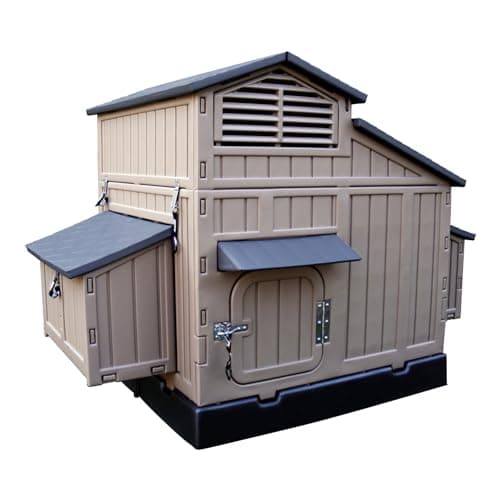
How many chickens should I get?
Flock sizing by household, yard and coop, with the space figures and the honest note about flocks growing.
Start Here
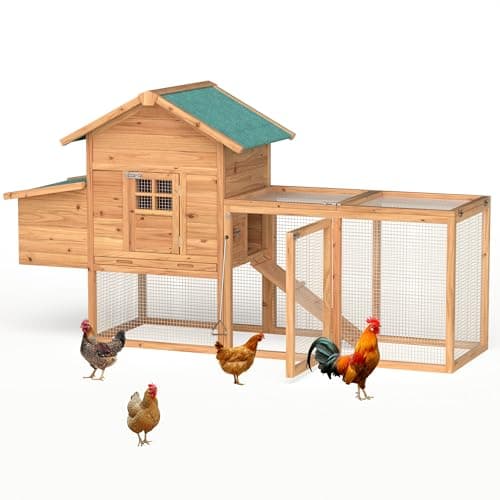
How many chickens can I have in my backyard?
How to find your local flock limit and what it usually restricts, then the published space arithmetic that decides how many birds your yard can actually hold.
Chicken Coops
Chicken coop size per chicken: the real numbers
The sizing table the rest of this site is built on, with the extension sources and a method for checking any listing.

Nesting Boxes
Why have my chickens stopped laying?
A diagnostic for a stopped flock: eight causes in order of likelihood, with what actually fixes each one.
Start Here
Raising chickens for beginners
The pillar guide for a first flock: how many birds, what they need, what it costs, and what to get right first.