Feeders & Feed
Grit and oyster shell: what each one actually does
One is a grinding stone. The other is calcium. Confusing them is the commonest feeding mistake in backyard flocks.
Chickens & Coops earns a commission when you buy through our links, at no extra cost to you. Prices come from Amazon and change; the date beside every price is when we last verified it. Full disclosure.
Quick picks
| # | Product | Type | Score | Price |
|---|---|---|---|---|
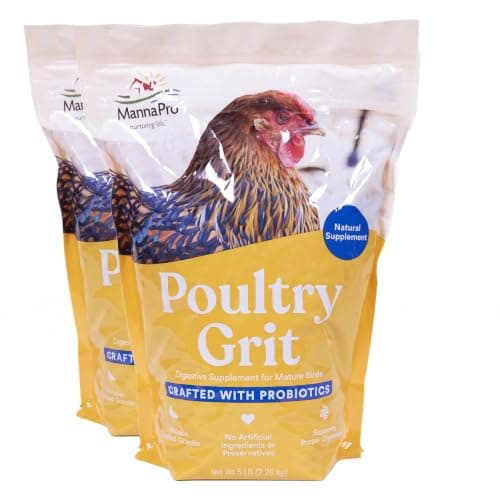
| Rank 1 | Manna Pro Poultry Grit with Probiotics, 5 lb Insoluble grit for hens eating anything but pellets | Insoluble crushed granite grit | 9.0 | $19.02on Amazon |
| Rank 2 | 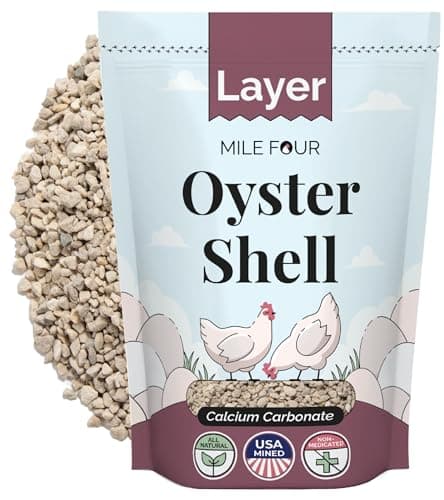 Mile Four Oyster Shell for Laying Hens, 4 lb Eggshell strength, offered free-choice | Crushed oyster shell | 8.8 | $19.99on Amazon |
| Rank 3 | 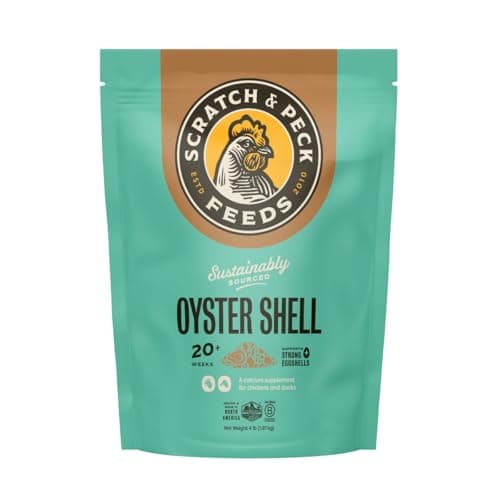 Scratch and Peck Feeds Oyster Shell, 4 lb Oyster shell from a feed brand you may already buy | Oyster shell | 8.5 | $19.95on Amazon |
#ad Prices come from Amazon and change. How this site is funded. Scores are our own published rubric, not a lab test — see how we pick.
These two bags sit next to each other in every feed store, look broadly similar, and do completely unrelated jobs. Getting them mixed up is the most common feeding error in backyard flocks — and both directions cause problems.
The difference in one table
| Insoluble grit | Oyster shell | |
|---|---|---|
| Material | Crushed granite or quartzite | Crushed oyster or seashell |
| Job | Grinds food in the gizzard | Supplies calcium for eggshells |
| Dissolves in the bird? | No — it has to stay hard | Yes — it has to dissolve |
| Needed by | Any bird eating grass, scratch, treats or scraps | Laying hens |
| Not needed by | Birds eating only complete feed | Chicks, pullets before lay, roosters |
| How to offer | Free-choice in its own dish | Free-choice in its own dish |
| Can it replace the other? | No | No |
Grit: the gizzard's teeth
Chickens have no teeth. Food is ground in the gizzard, a muscular organ that uses small hard stones the bird has swallowed to crush what it eats. A hen eating only complete crumble or pellets does not strictly need grit — the feed is already finely milled. The moment she eats grass, scratch grain, kitchen scraps, insects or anything with structure, she does.
This is why free-ranging birds always need grit. It must be insoluble — granite or quartzite — because something that dissolves cannot grind.
Chick grit is a different grade
Chicks that eat anything other than starter crumble need grit too, in a finer grade sold as chick grit. The same rule applies: if they are getting treats or foraging, they need it.
Oyster shell: calcium on demand
An eggshell is almost entirely calcium carbonate, and producing one every day or two is a substantial mineral demand. A complete layer feed is calcium-fortified and covers most hens. But demand varies enormously between individual birds — a hen laying daily needs far more than one in moult — and a bag of feed cannot adjust per bird.
Offering oyster shell free-choice solves this elegantly: the hens that need more take more. It is self-regulating in a way that mixing calcium into feed can never be.
Why not feed it to everyone
Excess calcium is a burden on the kidneys of birds that are not using it. Chicks, growing pullets before point of lay, and roosters should not be eating oyster shell. That is another argument for the separate dish: the birds that need it find it, and the ones that do not can ignore it.
How to offer both
- Two separate small dishes, not mixed into the feed and not mixed with each other.
- Somewhere dry and under cover, because both cake solid when wet.
- Topped up rather than refilled — consumption is low and erratic.
- Left available permanently. Free-choice is the whole mechanism.
A 4-5 lb bag of each lasts a small flock months. This is a cheap part of chicken keeping that has a disproportionate effect on shell quality and digestion.
What to buy
Insoluble granite grit and two oyster shell options — buy on price per pound.
#1 · Insoluble grit for hens eating anything but pellets
#ad How we are funded · Price as of October 5, 2026
Manna Pro Poultry Grit with Probiotics, 5 lb
Manna ProInsoluble crushed granite — the grinding stone a hen's gizzard needs to process grass, scratch and kitchen scraps. It is not a calcium supplement and does not replace oyster shell.
| Type | Insoluble crushed granite grit |
|---|---|
| Weight | 5 lb |
| Added | Probiotics |
| Function | Gizzard grinding material |
Specifications per Manufacturer figures as published on the Amazon product listing, as published at the date above.
What it does well
- States 'insoluble crushed granite', which is exactly what grit should be
- 5 lb lasts a small flock a very long time — it is offered free-choice, not mixed in
- Essential the moment hens eat anything other than a complete pellet
Where it falls short
- Routinely confused with oyster shell; they do different jobs and you need both
- Not needed at all for birds fed only complete crumble indoors
- Offer it in a separate small dish, not mixed into feed
Our rubric
- Fit for purpose
- 10.0
- Mess and waste
- 9.0
- Quality
- 9.0
- Value
- 8.0
#2 · Eggshell strength, offered free-choice
#ad How we are funded · Price as of October 5, 2026
Mile Four Oyster Shell for Laying Hens, 4 lb
Mile FourCrushed oyster shell as a free-choice calcium source. Layer feed already contains calcium; a separate dish of oyster shell lets the individual hens that need more take more.
| Type | Crushed oyster shell |
|---|---|
| Weight | 4 lb |
| Function | Calcium for egg-laying hens |
| Feeding | Free-choice |
Specifications per Manufacturer figures as published on the Amazon product listing, as published at the date above.
What it does well
- Free-choice calcium is self-regulating: hens laying hardest take the most
- Directly addresses thin and soft shells
- 4 lb lasts a small flock months
Where it falls short
- Not a substitute for grit — oyster shell dissolves, so it cannot grind
- Should never be fed to chicks or non-laying pullets
- Must go in its own dish, not mixed into the feed
Our rubric
- Fit for purpose
- 10.0
- Mess and waste
- 9.0
- Quality
- 9.0
- Value
- 7.0
#3 · Oyster shell from a feed brand you may already buy
#ad How we are funded · Price as of October 5, 2026
Scratch and Peck Feeds Oyster Shell, 4 lb
Scratch and Peck FeedsThe same job as any crushed oyster shell, from a brand that also makes whole-grain layer feeds. Buy on price per pound; the mineral is the mineral.
| Type | Oyster shell |
|---|---|
| Weight | 4 lb |
| For | Chickens and ducks |
| Feeding | Free-choice |
Specifications per Manufacturer figures as published on the Amazon product listing, as published at the date above.
What it does well
- Straightforward free-choice calcium
- 4 lb pouch reseals more easily than a paper sack
- Suits ducks as well as hens if you keep both
Where it falls short
- Nothing distinguishes it from other oyster shell beyond packaging
- Still not a grit substitute
- Premium brand pricing for a commodity mineral
Our rubric
- Fit for purpose
- 9.0
- Mess and waste
- 9.0
- Quality
- 9.0
- Value
- 7.0
Troubleshooting with these two
- Thin or soft shells → calcium. Check oyster shell is available and not caked solid, and that the feed is a proper layer ration.
- Whole undigested grain in droppings → grit. The gizzard has nothing to grind with.
- A hen eating her own eggs → often starts with a shell broken by weakness or by crowding in the nest. Fix the calcium and the nest box situation together.
- Pale, poor-quality shells across the whole flock → look at the feed first, then at age: shell quality declines naturally as a hen gets older, and no supplement reverses that.
Frequently asked questions
Is oyster shell the same as grit?
Do chickens need grit?
Should I mix grit into the feed?
Can roosters and chicks eat oyster shell?
Why are my hens' eggshells thin?
Sources
Read next
Feeders & Feed
The best chicken feed for laying hens
Complete layer feed options plus the grit and oyster shell that go alongside, and why those two are not the same thing.
Nesting Boxes
Why have my chickens stopped laying?
A diagnostic for a stopped flock: eight causes in order of likelihood, with what actually fixes each one.
Feeders & Feed
How much feed does a chicken eat per day?
The published figure, a table by flock size, and what makes real-world consumption differ from it.
Start Here
Choosing chickens for eggs
The five factors that actually drive laying, ranked, and the feed and nest gear that support them.
Nesting Boxes
The best nesting boxes for chickens
Our main nest box ranking, from a single plastic box to an eight-hole roll-away bank, with the box-count rule.