Chicken Coops
Chicken coop vs chicken tractor
A tractor saves your lawn and costs you security. Which way that trade falls depends almost entirely on your yard.
Chickens & Coops earns a commission when you buy through our links, at no extra cost to you. Prices come from Amazon and change; the date beside every price is when we last verified it. Full disclosure.
Quick picks
| # | Product | Mobility | Score | Price |
|---|---|---|---|---|
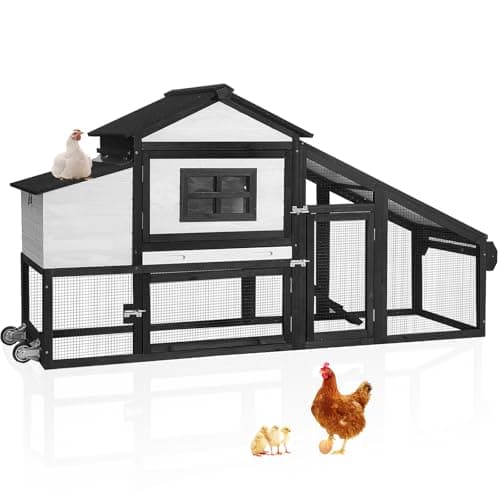
| Rank 1 | Aivituvin Mobile Chicken Coop with Wheels (2-4 hens) A starter flock you want to move around the lawn | Wheels fitted | 6.7 | $169.99on Amazon |
| Rank 2 | 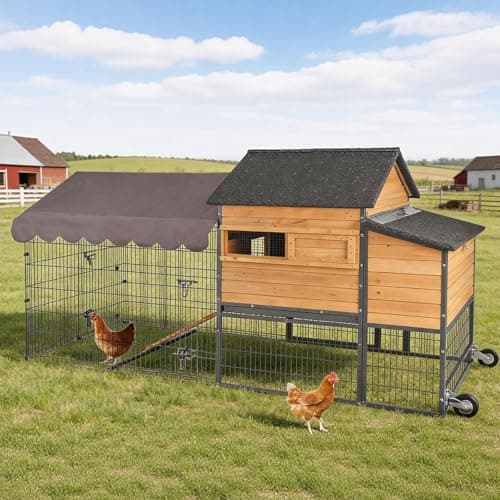 MEDEHOO Mobile Chicken Coop with Run (6-8 hens) A wheeled coop with a real asphalt-shingle roof | Wheels fitted | 7.0 | Check price on Amazon |
| Rank 3 | 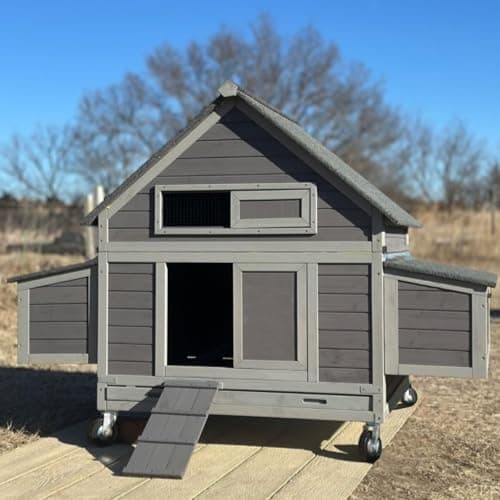 GUTINNEEN Chicken Coop on Wheels (6-8 hens) Six to eight hens you want to move without dismantling | Wheels fitted | 6.5 | $304.99on Amazon |
| Rank 4 | 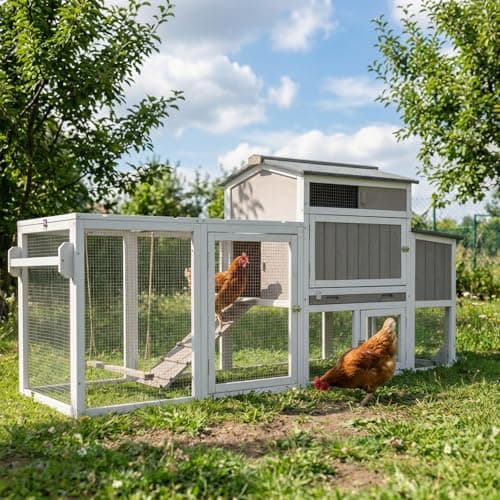 PetsCosset Mobile Chicken Tractor with Wheels The cheapest real chicken tractor | Wheels fitted | 6.5 | $109.69on Amazon |
| Rank 5 | 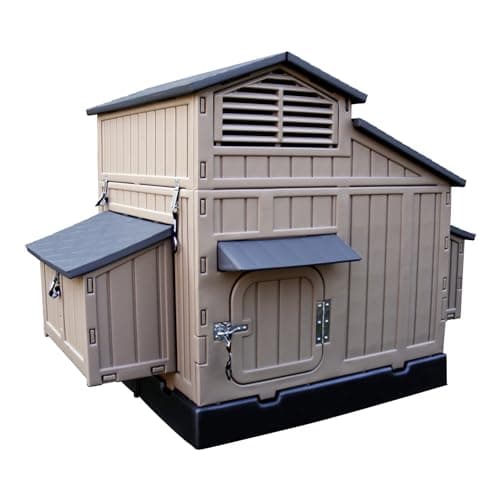 Hatching Time Formex Snap Lock Large Coop (4-6 hens) Six hens in a coop you can pressure-wash | Not published | 7.7 | $824.99on Amazon |
#ad Prices come from Amazon and change. How this site is funded. Scores are our own published rubric, not a lab test — see how we pick.
Buy a chicken tractor if your flock is small, your ground is grass you care about, and predators in your area are limited to daytime hawks and the occasional dog. Buy a fixed coop if you keep more than about six birds, if raccoons, foxes or weasels are present, or if your winters are hard. The tractor's advantage is the ground underneath it; its weakness is that nothing bolted to wheels can also be bolted to the earth.
A chicken tractor is simply a coop with wheels and usually an attached run, light enough to be dragged to fresh grass. The idea is older than the hardware: move the birds, and the ground they just left recovers while they fertilize it. The appeal is real and the limitations are specific, so this page works through both rather than picking a winner.
What a tractor actually fixes
One thing, and it is the thing most first-time keepers underestimate. A small fixed run is bare mud within weeks. Chickens scratch everything green out of a confined space quickly, and then the ground compacts, holds water, and turns into a source of mud and smell that no amount of bedding fixes. Move the same birds onto fresh grass weekly and neither happens: the grazed patch regrows and the droppings break down into it rather than accumulating.
University of Minnesota Extension's mobile poultry hut guidance is written around exactly that logic — mobility as a pasture-management tool rather than a convenience. The secondary benefits follow from it: less parasite build-up in the soil, more forage in the diet, and a yard that does not develop a permanent bald patch.
What a tractor costs you
Predator resistance, mostly
This is the serious one. The weakest point in any run is the ground, and the standard fix is a predator apron — hardware cloth laid flat or buried around the perimeter so a digging animal hits mesh. A tractor cannot have one, because it moves. A raccoon or fox working the edge of a tractor is working an unprotected seam.
Extension's predator guidance notes that chicken wire's openings let ground predators reach in and that least weasels can get through quarter-inch holes, which matters more on a tractor than on a fixed coop because there is less you can do to compensate. The honest mitigation is to make the house itself genuinely secure, latch it every night, and accept that the run is a daytime space.
Weight, and therefore size
A tractor has to be light enough to move, which caps how big it can be. In practice anything above about eight birds needs two adults to shift, at which point it stops getting moved and becomes a fixed coop with a mud problem and wheels. Be honest about who is going to move it and how often.
Winter
A tractor sits on grass, which means it cannot be sited on a dry base, insulated under the floor, or wired for power without undoing the mobility. In a mild winter that is fine. In a hard one, a fixed coop on a level base is simply the better building.
Side by side
| Chicken tractor | Fixed coop | |
|---|---|---|
| Ground underneath | Recovers between moves | Bare and compacted within weeks unless the run is large |
| Predator apron possible | No — it moves | Yes, and it should have one |
| Practical flock size | Up to about 6-8 birds | Any size |
| Weight | Must be liftable, which caps the build | Irrelevant — build it heavy |
| Power at the coop | No | Yes, which opens up heated water and lighting |
| Winter performance | Adequate in mild climates | Better: dry base, insulation, power |
| Forage in the diet | Meaningful | Only if they free-range |
| Cost per bird housed | Higher | Lower at any size above a few birds |
The picks
Three mobile coops at different flock sizes, the cheapest genuine tractor, and the fixed plastic coop we would buy instead.
#1 · A starter flock you want to move around the lawn
#ad How we are funded · Price as of October 10, 2026
Aivituvin Mobile Chicken Coop with Wheels (2-4 hens)
AivituvinA wheeled, expandable coop-and-run for 2-4 birds. The wheels are the point: moving it weekly stops the ground underneath turning to bare mud, which is the usual fate of a fixed small run.
| Stated capacity | 2-4 chickens |
|---|---|
| Nesting boxes | 2 |
| Mobility | Wheels fitted |
| Run | Attached, expandable |
| Floor area | Not published by manufacturer |
Specifications per Manufacturer figures as published on the Amazon product listing, as published at the date above.
What it does well
- Wheels mean you can rotate it and let grass recover — a real husbandry advantage, not a gimmick
- Attached run means it works out of the box without building a second enclosure
- Two nest boxes for up to four hens is correct, not padded
- Expandable run section adds space without replacing the coop
Where it falls short
- No floor-area figure published, so capacity has to be taken on trust
- Wheeled coops are light by design, which also means easier for a determined raccoon to work at
- An attached run on a mobile coop is rarely tall enough to stand in
Our rubric
- Space per bird
- 6.0
- Predator resistance
- 5.0
- Ventilation
- 7.0
- Cleaning access
- 7.0
- Build
- 7.0
- Value
- 8.0
#2 · A wheeled coop with a real asphalt-shingle roof
#ad How we are funded · No buyable offer at the last price check
MEDEHOO Mobile Chicken Coop with Run (6-8 hens)
MEDEHOOA mobile coop-and-run for 6-8 birds with a weatherproof asphalt roof rather than painted ply. The roof is why this one survives a third winter when cheaper wheeled coops do not.
No buyable offer at the last price check. The listing still resolves, so this may be a temporary stock gap rather than a discontinued model.
| Stated capacity | 6-8 chickens |
|---|---|
| Roof | Weatherproof asphalt |
| Mobility | Wheels fitted |
| Run | Attached, large |
| Floor area | Not published by manufacturer |
Specifications per Manufacturer figures as published on the Amazon product listing, as published at the date above.
What it does well
- Asphalt roofing is the single best durability upgrade on a wooden coop and it is fitted here
- Attached large run plus wheels is the combination that keeps ground healthy
- Sized for a realistic backyard flock rather than two birds
Where it falls short
- No interior floor area published
- Asphalt adds weight on top, which makes the coop harder to move single-handed
- Supplied mesh will still need upgrading for raccoon country
Our rubric
- Space per bird
- 7.0
- Predator resistance
- 6.0
- Ventilation
- 7.0
- Cleaning access
- 7.0
- Build
- 8.0
- Value
- 7.0
#3 · Six to eight hens you want to move without dismantling
#ad How we are funded · Price as of October 10, 2026
GUTINNEEN Chicken Coop on Wheels (6-8 hens)
GUTINNEENA 67-inch weatherproof wooden coop on wheels for 6-8 birds. At this size a mobile coop stops being a novelty and starts saving your lawn — but it needs two adults to move.
| Stated capacity | 6-8 chickens |
|---|---|
| Length | 67.3 in |
| Mobility | Wheels fitted |
| Weatherproofing | Weatherproof roof (type not specified) |
| Floor area | Not published by manufacturer |
Specifications per Manufacturer figures as published on the Amazon product listing, as published at the date above.
What it does well
- Published length, so the footprint is checkable
- Wheels at an eight-bird size are rare and genuinely useful for rotating ground
- Weatherproof roof rather than bare ply is the right call in this price band
Where it falls short
- No floor area published; eight standard hens need roughly 32 sq ft inside
- Heavy enough that moving it is a two-person job
- Wheels add ground clearance, which also means a gap a predator can work under
Our rubric
- Space per bird
- 6.0
- Predator resistance
- 5.0
- Ventilation
- 7.0
- Cleaning access
- 7.0
- Build
- 7.0
- Value
- 7.0
#4 · The cheapest real chicken tractor
#ad How we are funded · Price as of October 10, 2026
PetsCosset Mobile Chicken Tractor with Wheels
PetsCossetA weatherproof wheeled hen house with a nest box and roosting bar. Not large, but it is a genuine tractor at a price where most wheeled coops are toys.
| Mobility | Wheels fitted |
|---|---|
| Nesting box | Included |
| Roosting bar | Included |
| Weatherproofing | Weatherproof construction |
| Stated capacity | Not published by manufacturer |
| Floor area | Not published by manufacturer |
Specifications per Manufacturer figures as published on the Amazon product listing, as published at the date above.
What it does well
- Publishes that it has a roosting bar — more listings leave hens to sleep in the nest box
- Wheels at this price point are rare
- Light enough for one adult to move daily, which is the whole point of a tractor
Where it falls short
- No stated capacity or floor area; treat it as a three-to-four-hen house
- Light construction is the trade-off for being movable
- Needs to be moved regularly or the ground beneath it will still be ruined
Our rubric
- Space per bird
- 5.0
- Predator resistance
- 5.0
- Ventilation
- 7.0
- Cleaning access
- 7.0
- Build
- 6.0
- Value
- 9.0
#5 · Six hens in a coop you can pressure-wash
#ad How we are funded · Price as of October 10, 2026
Hatching Time Formex Snap Lock Large Coop (4-6 hens)
Hatching TimeThe larger Formex coop, stated for 4-6 birds. Same argument as the standard model — a non-porous double wall, no mite harborage, hose-out cleaning — with room for a realistic six-hen flock.
| Stated capacity | 4-6 chickens |
|---|---|
| Material | Formex structural foam (double wall) |
| Assembly | Snap-together |
| Ventilation | Built-in vents |
| Floor area | Not published by manufacturer |
Specifications per Manufacturer figures as published on the Amazon product listing, as published at the date above.
What it does well
- Nothing for red mite to hide in, which is the problem wooden coops never fully solve
- Washes down to clean in minutes — the difference between cleaning weekly and meaning to
- Insulated wall moderates both winter cold and summer heat
- No rot, no repainting, no re-sealing, ever
Where it falls short
- Expensive next to a wooden coop of the same stated capacity
- Must be anchored — light enough to shift in strong wind
- No published floor area, so the 4-6 claim cannot be checked on paper
Our rubric
- Space per bird
- 7.0
- Predator resistance
- 7.0
- Ventilation
- 8.0
- Cleaning access
- 10.0
- Build
- 9.0
- Value
- 5.0
Sizing still applies — and it is stricter on a tractor
The space arithmetic does not relax because the coop has wheels. Penn State Extension puts a large chicken at 2 sq ft of coop floor and 10 sq ft of run; lighter laying breeds at 1.5 and 8. A tractor advertised for six hens almost always provides a fraction of that run area, and the justification offered is that the birds get fresh grass. That only holds if the thing is genuinely moved on schedule.
| Flock size | Coop floor (standard hens) | Run space | Roost length | Nest boxes |
|---|---|---|---|---|
| 2 hens | 4 sq ft | 16-20 sq ft | 12 in | 2 |
| 4 hens | 8 sq ft | 32-40 sq ft | 24 in | 2 |
| 6 hens | 12 sq ft | 48-60 sq ft | 36 in | 3 |
| 8 hens | 16 sq ft | 64-80 sq ft | 48 in | 3 |
| 10 hens | 20 sq ft | 80-100 sq ft | 60 in | 4 |
| 12 hens | 24 sq ft | 96-120 sq ft | 72 in | 4 |
| 20 hens | 40 sq ft | 160-200 sq ft | 120 in | 6 |
The middle path most people end up on
A compact secure house inside a large covered run, with the birds let out onto grass under supervision. It gives you the fixed coop's security and power, and recovers some of the tractor's forage benefit without the weekly drag. For a yard with room, it is usually the better answer than either pure option — coops with runs and walk-in coops are where that configuration lives.
What a tractor costs to keep running
The ongoing costs of a tractor are not financial, they are labor and attention, and they are worth knowing before you commit. Moving it is a job: on grass, twice a week, in whatever weather the week brings. The skirt that protects the perimeter has to be checked after each move, because a skirt riding up on uneven ground is a skirt doing nothing. And because there is no power at the structure, the nightly shut-up is manual rather than automatic, so the one thing that most reliably prevents losses depends entirely on you doing it.
A fixed coop's costs are front-loaded instead. It takes a base, an apron and a run of the right size, and once those exist the daily job is smaller: an automatic door can shut itself, a heated waterer can stay liquid, and the ground does not need managing because it was prepared once. Neither pattern is better in the abstract. They suit different people, and the honest question is which kind of work you would rather do every week for the next several years.
If you do go mobile, read predator-proofing a chicken tractor before the birds move in — the mitigations are real, but they have to be fitted rather than assumed.
Frequently asked questions
Is a chicken tractor better than a coop?
How often should you move a chicken tractor?
Are chicken tractors predator proof?
How many chickens fit in a chicken tractor?
Do chicken tractors work in winter?
Sources
Read next
Chicken Coops
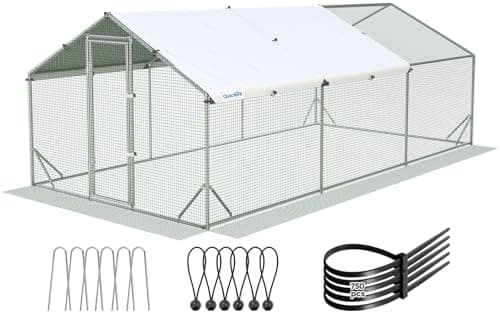
The best mobile chicken coops and chicken tractors
Wheeled coops and tractors, judged on whether they genuinely move and whether the ground recovers when they do.
Chicken Coops
Chicken coop vs chicken run
What a coop is for, what a run is for, and the five-to-one floor-area ratio between them — plus four runs sized by published square footage.
Chicken Coops
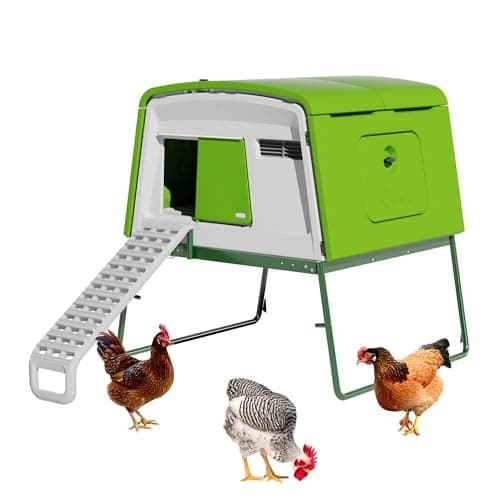
The best chicken coops for a backyard flock
Our main coop ranking, from a two-hen starter box to a twenty-bird shed, with the space maths done for you.
Predator Protection
Predator proofing a chicken tractor
How to secure a mobile coop when a buried apron is not an option: a traveling skirt, half-inch mesh, a two-step latch, and the honest limits.
Chicken Coops
Chicken coop size per chicken: the real numbers
The sizing table the rest of this site is built on, with the extension sources and a method for checking any listing.