Predator Protection
How to fit a predator apron
A flat band of mesh around the base of the run. No digging, grass grows through it, and it stops the predators that dig.
Chickens & Coops earns a commission when you buy through our links, at no extra cost to you. Prices come from Amazon and change; the date beside every price is when we last verified it. Full disclosure.
Quick picks
| # | Product | Mesh | Score | Price |
|---|---|---|---|---|
| Rank 1 | Hardware Cloth, 1/2in Mesh, 16in x 50ft, 19 Gauge A predator apron around an existing run | 1/2 in | 8.8 | $24.96on Amazon |
| Rank 2 | 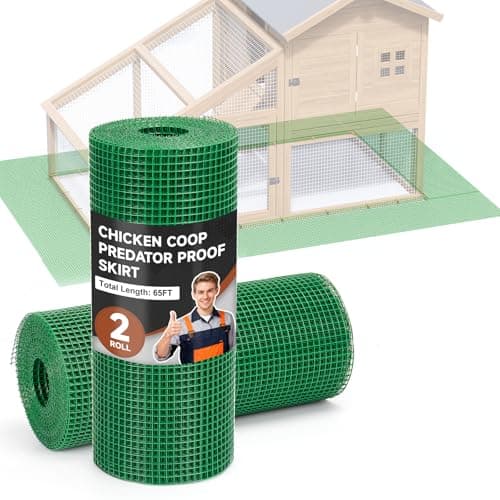 BJADE'S Chicken Coop Predator Proof Apron A ready-made dig barrier | Not published | 7.8 | $58.99on Amazon |
| Rank 3 | 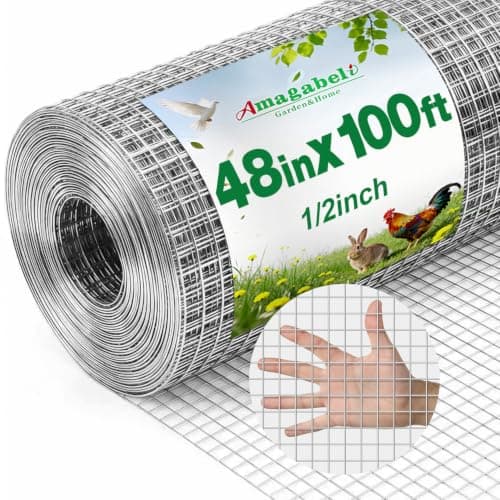 Amagabeli Hardware Cloth, 1/2in Mesh, 48in x 100ft, 19 Gauge The mesh that actually stops raccoons | 1/2 in | 8.4 | $79.99on Amazon |
| Rank 4 | 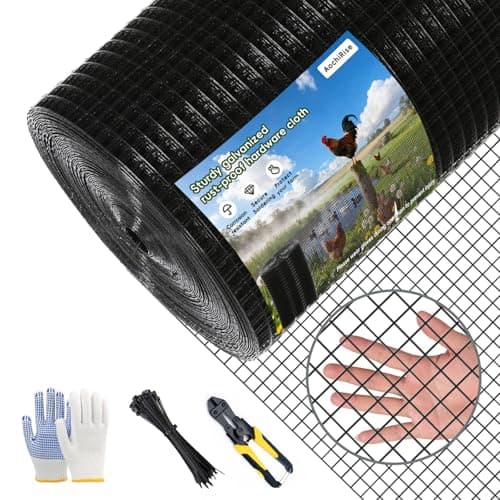 Black Vinyl Coated Hardware Cloth, 1/2in Mesh, 19 Gauge Mesh you can actually see through | 1/2 in | 8.4 | $59.99on Amazon |
#ad Prices come from Amazon and change. How this site is funded. Scores are our own published rubric, not a lab test — see how we pick.
A sound coop with good mesh and a proper latch can still be entered from below. Foxes, dogs and to a lesser extent raccoons and skunks dig, and a run with no barrier at the ground line is a run with a door in the floor. The fix is a predator apron: a band of hardware cloth laid flat on the ground, extending outward from the base of the run, pinned down and grown over by grass.
Why flat beats buried
UNH Extension suggests burying hardware cloth at least 12 inches into the ground to deter diggers, and that works. A surface apron achieves the same result for far less effort, and here is the reason it works:
A digging predator starts at the base of the wall, because that is where the scent and the sound are. It hits mesh immediately and cannot get through. It does not then reason that it should back off two feet and start digging from further out. That behavioral fact is what makes a 16-inch surface apron as effective as a buried skirt, and it is the whole argument.
| Flat apron | Buried skirt | |
|---|---|---|
| Digging required | None | A 12 in trench round the whole perimeter |
| Time | An afternoon | A weekend |
| Effectiveness | Equivalent in practice | Equivalent |
| Grass | Grows through it and hides it | Not visible at all |
| Inspection | Easy — you can see it | Cannot be checked without digging |
| Rust | Slower — not in constant wet soil | Faster |
| Mowing | Keep the mower blade high over it | No issue |
What to buy
- Half-inch hardware cloth, 19 gauge. The same specification as everything else in this hub.
- A 16-inch wide roll if you can get one. It is the right width for an apron and far easier to handle alone than a 48-inch roll.
- Landscape staples or heavy galvanized U-pins, a lot of them. Every 12 inches or so.
- Gloves. Cut hardware cloth is genuinely sharp.
- Galvanized washers and screws or poultry staples to fix the apron to the run frame.
What to buy
The 16-inch apron roll, a ready-made apron, and two full-width rolls if you are doing walls at the same time.
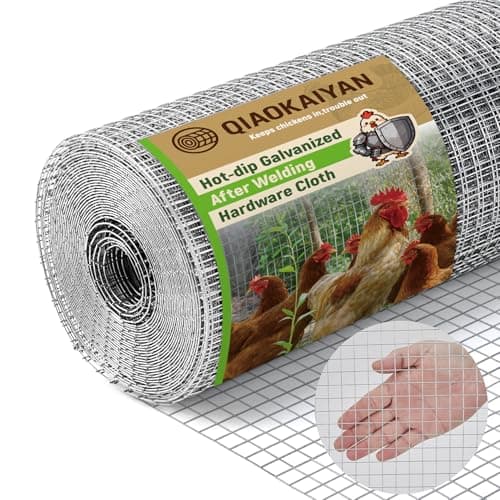
#1 · A predator apron around an existing run
#ad How we are funded · Price as of October 5, 2026
Hardware Cloth, 1/2in Mesh, 16in x 50ft, 19 Gauge
GenericA narrow 16-inch roll of the same half-inch, 19-gauge hot-dipped mesh. Sixteen inches is exactly the width you want for a predator apron laid flat around the base of a run.
| Mesh | 1/2 in |
|---|---|
| Gauge | 19 |
| Size | 16 in x 50 ft |
| Coating | Hot-dipped galvanized |
Specifications per Manufacturer figures as published on the Amazon product listing, as published at the date above.
What it does well
- 16 in width is the right apron dimension — wide enough that a digging fox gives up
- Same half-inch, 19-gauge specification as the full-height rolls
- Cheap enough to apron a whole run without a second thought
- Narrow roll is far easier to handle alone than a 48 in one
Where it falls short
- Too short for run walls — this is an apron roll, not a fencing roll
- Still needs pinning down with landscape staples
- Sharp cut edges
Our rubric
- Predator resistance
- 9.0
- Install effort
- 6.0
- Durability
- 9.0
- Reliability
- 10.0
- Value
- 10.0
#2 · A ready-made dig barrier
#ad How we are funded · Price as of October 5, 2026
BJADE'S Chicken Coop Predator Proof Apron
BJADE'SA purpose-made apron skirt for the base of a coop or run. Buying it ready-made costs more than a roll of hardware cloth but removes the part people skip: cutting and edging the mesh.
| Type | Predator-proof apron / dig barrier |
|---|---|
| Use | Coop and run perimeter |
| Dimensions | Not published by manufacturer |
| Mesh gauge | Not published by manufacturer |
Specifications per Manufacturer figures as published on the Amazon product listing, as published at the date above.
What it does well
- Arrives as an apron, so there is no cutting, edging or measuring
- Digging is how foxes and dogs get into otherwise sound runs — an apron is the fix
- Faster to install than a hardware cloth roll
Where it falls short
- Neither dimensions nor gauge are published, which on a barrier product matters
- More expensive per foot than cutting your own from a roll
- Still needs staking down properly to work
Our rubric
- Predator resistance
- 8.0
- Install effort
- 9.0
- Durability
- 7.0
- Reliability
- 8.0
- Value
- 7.0
#3 · The mesh that actually stops raccoons
Amagabeli Hardware Cloth, 1/2in Mesh, 48in x 100ft, 19 Gauge
AmagabeliHot-dipped galvanized-after-welding half-inch hardware cloth in 19 gauge. This is the specification to buy: half-inch openings keep weasels out, and galvanized-after-welding means the weld points do not rust first.
| Mesh | 1/2 in |
|---|---|
| Gauge | 19 |
| Size | 48 in x 100 ft |
| Coating | Hot-dipped galvanized after welding |
Specifications per Manufacturer figures as published on the Amazon product listing, as published at the date above.
What it does well
- Half-inch openings are small enough to stop weasels, which 1 in mesh is not
- Galvanized AFTER welding — the welds are coated, so the mesh does not rust at the joints first
- 19 gauge resists a raccoon's hands, which hexagonal chicken wire does not
- 400 sq ft covers the lower half of most runs
Where it falls short
- Several times the price of hexagonal chicken wire for the same area
- Stiff and sharp to work with — gloves are not optional
- Heavy: a 100 ft roll is a two-person lift
Our rubric
- Predator resistance
- 10.0
- Install effort
- 5.0
- Durability
- 10.0
- Reliability
- 10.0
- Value
- 7.0
#4 · Mesh you can actually see through
Black Vinyl Coated Hardware Cloth, 1/2in Mesh, 19 Gauge
GenericThe same half-inch 19-gauge mesh with a black vinyl coating. The coating adds rust life, and black mesh visually disappears — you can see your hens instead of a silver grid.
| Mesh | 1/2 in |
|---|---|
| Gauge | 19 |
| Coating | Galvanized with black vinyl |
| Dimensions | Not published by manufacturer |
Specifications per Manufacturer figures as published on the Amazon product listing, as published at the date above.
What it does well
- Vinyl over galvanizing is the longest-lasting coating combination for a coop run
- Black mesh is far less visually obtrusive from the house
- Same predator-stopping half-inch, 19-gauge specification
Where it falls short
- Roll dimensions are not published on this listing
- Vinyl coating costs more than plain galvanized
- Cut edges expose bare steel and will rust unless painted
Our rubric
- Predator resistance
- 10.0
- Install effort
- 5.0
- Durability
- 10.0
- Reliability
- 10.0
- Value
- 7.0
Fitting it, step by step
- Clear the perimeter. Strim the grass right down against the run and remove stones so the mesh can lie flat.
- Unroll the mesh along one side, flat on the ground, with one long edge against the base of the run.
- Fix the inner edge to the run frame with poultry staples or screws and washers, every few inches. This join is the important part — a gap between the apron and the wall is a hole.
- Lay the apron outward, flat. 16 inches is plenty; 12 is the practical minimum.
- Pin it down with landscape staples every 12 inches, and more at the corners.
- Overlap at the corners by several inches, both layers pinned.
- Cover it with a thin layer of soil or let grass grow through. Within a season it disappears.
- Mind the mower. Mark the outer edge, and keep the blade high over it.
The places people miss
- Corners. The commonest failure point — overlap generously and pin heavily.
- The gate or door threshold. Run the apron across it, or fit a solid sill.
- Where the run meets a wall or fence. A predator will work along the wall to find the gap.
- Under the coop itself, if it stands on legs with open ground beneath. Apron the coop footprint too, or skirt it.
- The point where a path or paving meets the run — the join is a weak line.
Maintenance
- Walk the perimeter at every thaw. Ground that freezes and softens is when digging attempts start, and when a pin can lift.
- Check after heavy rain, which can wash soil off and expose edges.
- Re-pin anything lifted. An apron with a lifted corner is an apron with a handle on it.
- Look for fresh digging at the wall line. A scrape against intact mesh means something tried and failed — which is the apron working, and a reason to check everything else.
What an apron does not do
It stops digging. It does nothing about climbing, reaching through mesh, opening latches, or hawks. It is one of five measures — hardware cloth on the walls, a two-step latch, a door shut at dusk, an apron, and electric netting if you free-range. The full picture.
Frequently asked questions
What is a predator apron?
How wide should a predator apron be?
Is a flat apron as good as burying the wire?
What mesh should a predator apron be?
Do I need an apron on a mobile coop?
Sources
Read next
Predator Protection
Chicken wire vs hardware cloth
The single most useful distinction in predator protection, with the gauges, the openings and where each belongs.
Predator Protection
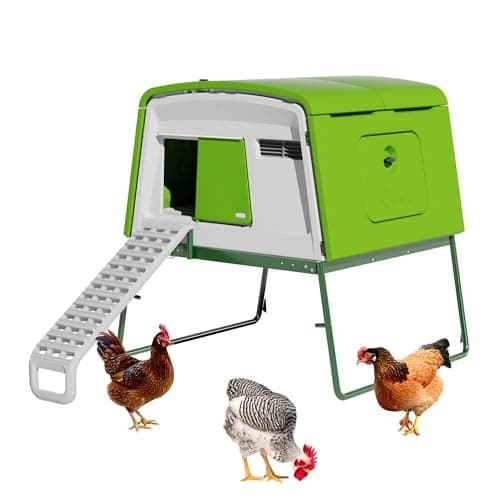
The most predator-resistant chicken coops
The coops with the best predator record, plus the three upgrades almost every coop needs whatever the listing claims.
Predator Protection
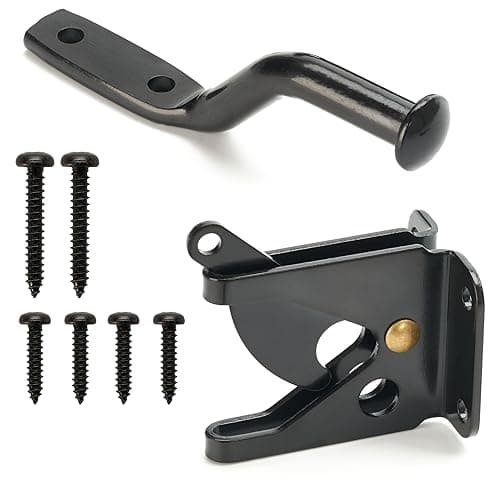
How to keep raccoons out of a chicken coop
Five changes that stop raccoons, in order of effect, plus why the feed store is part of the problem.
Predator Protection
The main chicken predators, and what stops each one
An identification guide: what each predator does, how to tell which one visited, and the one measure that stops it.
Chicken Coops
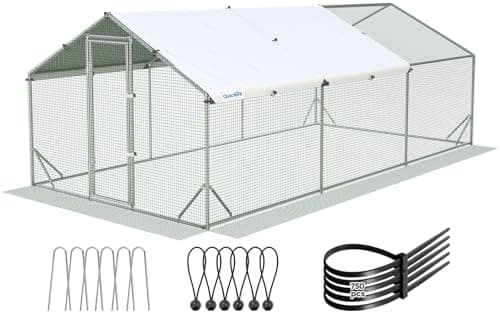
The best walk-in chicken coops and runs
Coops and runs with standing headroom, ranked on height, floor area and whether the mesh is actually hardware cloth.