Chicken Coops
How much does a chicken coop cost?
The spread between the cheapest and the dearest coop on this page is roughly twentyfold, and almost none of it is about how many hens fit.
Chickens & Coops earns a commission when you buy through our links, at no extra cost to you. Prices come from Amazon and change; the date beside every price is when we last verified it. Full disclosure.
Top pick
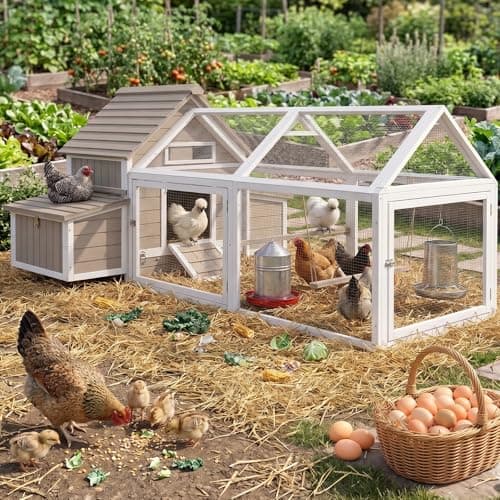
Ketive 83-inch Chicken Coop with Run (4-6 hens)
83 inches of coop-and-run for 4-6 birds.
#ad How we are funded · Price as of November 8, 2026
Quick picks
| # | Product | Stated capacity | Score | Price |
|---|---|---|---|---|
| Rank 1 | Ketive 83-inch Chicken Coop with Run (4-6 hens) The most run length per dollar at six hens | 4-6 chickens | 8.7 | $159.99Ketive 83-inch |
| Rank 2 | 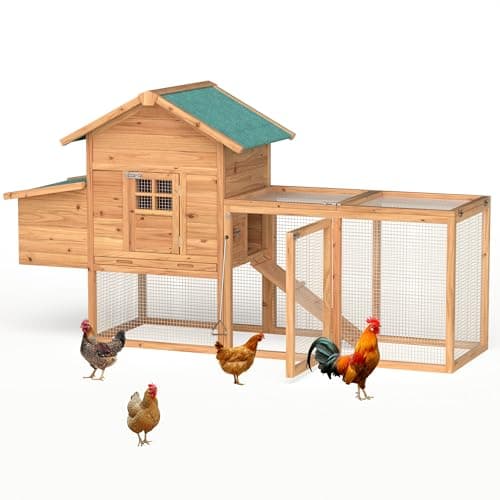 GOJOOASIS Wooden Hen House (2-5 hens) A simple, cheap first coop with a pull-out tray | 2-5 chickens | 8.5 | $169.99GOJOOASIS Wooden Hen |
| Rank 3 | 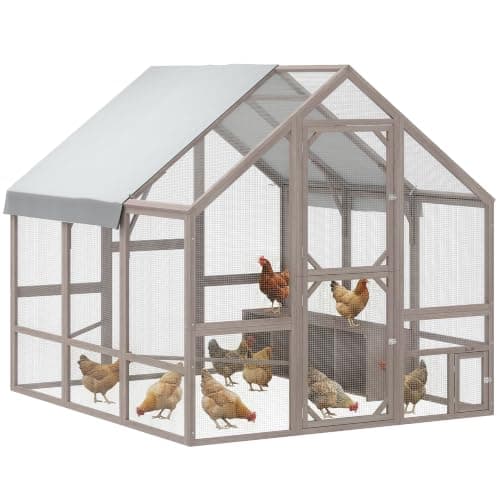 PawHut Large Wooden Chicken Coop, 83in x 73in x 73in Eight to ten hens in a coop you can walk into | 8-10 hens | 9.2 | $399.99PawHut Large Wooden |
| Rank 4 | 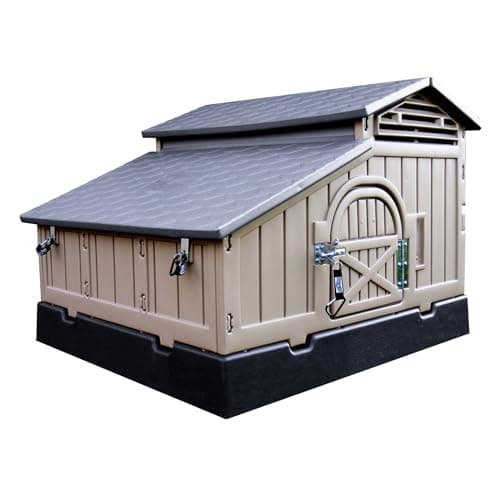 Hatching Time SnapLock Formex Standard Coop Four hens, and never scrubbing wood again | 4 chickens | 9.2 | $549.99Hatching Time |
| Rank 5 | 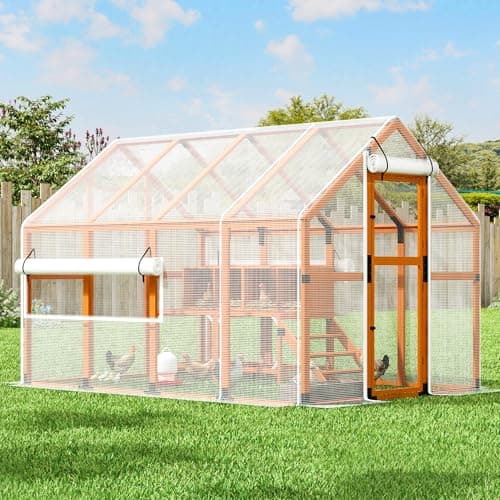 COZIWOW 9ft Extra Large Coop with Full Waterproof Cover A big covered run without building one | Not published | 8.9 | $592.99COZIWOW 9ft Extra |
| Rank 6 | 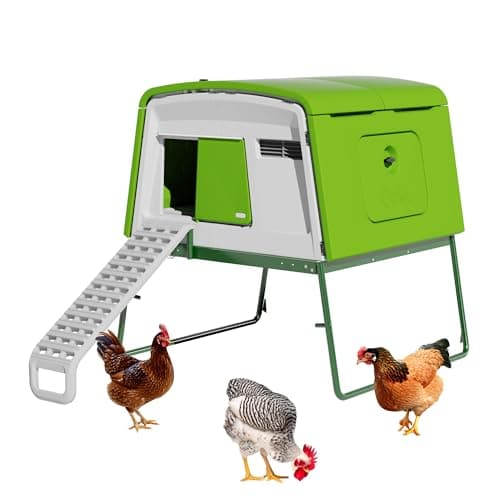 Omlet Eglu Cube Large Buy-it-once plastic, with the strongest predator record | Not published | 9.4 | $1,399.00Omlet Eglu Cube |
#ad Prices come from Amazon and change. How this site is funded. Scores are our own published rubric, not a lab test — see how we pick.
A backyard chicken coop spans roughly twentyfold from the cheapest to the dearest, and the money is not buying bird capacity. It is buying four things: usable floor area, whether a run comes with it, whether you can stand up inside, and how many winters the structure survives. Capacity claims move far less than price does, which is exactly why shopping on the stated bird count leads people wrong.
Every price in the table below is pulled live and carries the date it was checked. Nothing on this page quotes a number from memory, and the prose talks in tiers and multiples rather than dollar figures for the same reason — a figure typed into a sentence is wrong within a week.
First: the number that decides whether any of it is good value
Penn State Extension's small-scale poultry housing guidance puts a large chicken at 2 square feet of coop floor plus run space, and the figure most backyard keepers are better served by is 4 square feet per bird where the flock is confined for long stretches of winter. Multiply the coop's stated interior dimensions, divide by that, and compare the answer to the bird count on the box.
Do that across a price range and a pattern appears immediately: capacity claims are roughly double the honest figure at every tier, including the expensive ones. A pricier coop is not usually a bigger coop. It is a better-built coop of a similar size. Chicken coop size per chicken works the arithmetic through properly, and it is the single most useful thing to read before spending anything.
Tier 1 — a raised hutch, no run
The cheapest thing sold as a chicken coop is a small raised timber box with a nest compartment and a pull-out tray. It is a roost-and-lay house, not a complete home, and it is honest value only if you already have a fenced run or intend to build one.
- What you get: a dry, elevated sleeping and laying space, a slide-out tray that makes weekly cleaning a thirty-second job, and a footprint that fits a genuinely small yard.
- What you do not get: run space, a latch a raccoon cannot work, or panel stock that survives a wet climate without resealing in year one.
- Buy this if the run already exists, the flock is two or three birds, and you are comfortable upgrading the mesh and the latch yourself.
Tier 2 — a coop with an attached run
The volume tier, and where most first-time buyers land. A raised house at one end, a wire run at the other, assembled from flat-pack panels. The run is the reason this tier exists: it turns the purchase into a complete setup rather than the first half of one.
- What you get: housing and outdoor space in one delivery, usually a nest box or two, and an asking price close to tier 1 because the extra material is cheap wire and softwood.
- What you do not get: standing room, an honest bird count, or hardware cloth. The supplied mesh is almost always chicken wire, which is not a predator barrier whatever the listing implies.
- Buy this if you want one purchase that works on day one and you are willing to spend a Saturday re-meshing the run.
Tier 3 — a walk-in you can stand up in
Two to three times tier 2, and the first tier where the structure changes rather than just getting larger. A walk-in coop has a human-height door, a floor you can reach every corner of, and usually a run tall enough to work in.
- What you get: the ability to clean properly, which is the feature that actually gets used. A coop you dread cleaning is a coop that does not get cleaned, and every husbandry problem downstream — mites, ammonia, dirty eggs — traces back to that.
- What you do not get: a change in material quality. Most walk-ins at this tier are the same softwood and asphalt-felt construction as tier 2, just more of it.
- Buy this if the flock is six or more, or if your back has an opinion about kneeling in a doorway twice a week.
Walk-in chicken coops is the dedicated ranking for this tier, and the best coops with runs covers the step below it.
Tier 4 — structural plastic, bought once
A different argument entirely. Double-wall structural foam or molded plastic costs roughly the same as a large timber walk-in, houses fewer birds, and is bought for one reason: there is nowhere in the wall for red mite to live, and the whole thing hoses out in minutes.
- What you get: no rot, no repainting, no resealing, no mite harborage in the grain, and a cleaning routine measured in minutes. Insulating wall sections moderate both winter cold and summer heat better than thin ply.
- What you do not get: floor area per dollar. You are paying plastic-coop money for a flock a cheaper timber coop would house, and the unit is light enough that it must be anchored against wind.
- Buy this if you have fought mites in a wooden coop, or you know yourself well enough to know that "I will reseal it every spring" is not true.
Plastic vs wood chicken coops is the full version of this argument, with the trade-offs in both directions.
Tier 5 — the decade purchase
Several times tier 4, and bought by people who have already replaced one cheap coop. At this tier you get cabinet-grade construction, real hardware, a roof specified in years rather than seasons, and a brand with a parts history — or, on the premium plastic side, a system with a warranty measured in a decade.
- What you get: a structure that is still square after five winters, latches that were designed rather than selected on price, and resale value that genuinely exists.
- What you do not get: anything a tier 3 or tier 4 coop does not also do in principle. This is reliability and finish, not capability.
- Buy this if you intend to keep chickens for a decade, you have the space fixed, and replacing a coop in three years would annoy you more than the price does now.
Every tier, with today's price
One or two representatives of each tier, cheapest first. The price column is live and carries its own as-of date.
#1 · The most run length per dollar at six hens
#ad How we are funded · Price as of November 8, 2026
Ketive 83-inch Chicken Coop with Run (4-6 hens)
Ketive83 inches of coop-and-run for 4-6 birds. The published length is the useful number here: it is one of the few listings in this band that tells you the footprint before you buy.
| Stated capacity | 4-6 chickens |
|---|---|
| Overall length | 83 in |
| Run | Attached |
| Construction | Wood frame |
| Nesting box | Yes, integrated |
Specifications per Manufacturer figures as published on the Amazon product listing, as published at the date above.
Why we picked it
- Published overall length, so you can mark it out on the lawn before ordering
- Long, narrow footprint fits down the side of a house where square coops will not
- Run and house in one purchase
Good to know — 83 inches total includes the run, so the house itself is small for six hens
Our rubric
- Space per bird
- 8.4
- Predator resistance
- 7.9
- Ventilation
- 8.9
- Cleaning access
- 8.9
- Build
- 8.4
- Value
- 9.8
#2 · A simple, cheap first coop with a pull-out tray
#ad How we are funded · Price as of November 8, 2026
GOJOOASIS Wooden Hen House (2-5 hens)
GOJOOASISA conventional raised wooden hutch with a pull-out tray, stated for 2-5 birds. Sensible for two or three hens with a separate run; five is optimistic.
| Stated capacity | 2-5 chickens |
|---|---|
| Construction | Wood, raised on legs |
| Cleaning | Pull-out tray |
| Nesting box | Yes, integrated |
| Floor area | Not published by manufacturer |
Specifications per Manufacturer figures as published on the Amazon product listing, as published at the date above.
Why we picked it
- Raised design puts the floor above ground damp and gives the birds shade underneath
- Pull-out tray is the feature that decides whether you actually clean a coop weekly
- Simple construction means fewer parts to fail and easy repairs with offcuts
Good to know — Stated 2-5 capacity is a wide range; plan for the low end
Our rubric
- Space per bird
- 7.9
- Predator resistance
- 7.9
- Ventilation
- 8.4
- Cleaning access
- 9.3
- Build
- 8.4
- Value
- 9.3
#3 · Eight to ten hens in a coop you can walk into
$419.99 5% off
#ad How we are funded · Price as of November 8, 2026
PawHut Large Wooden Chicken Coop, 83in x 73in x 73in
PawHutThe rare large coop that publishes all three dimensions: 83 x 73 x 73 inches for 8-10 hens. 73 inches of height is the number that matters — you can stand up inside it to clean.
| Stated capacity | 8-10 hens |
|---|---|
| Dimensions | 83 in L x 73 in W x 73 in H |
| Footprint | About 42 sq ft |
| Construction | Wood |
| Finish | Light brown |
Specifications per Manufacturer figures as published on the Amazon product listing, as published at the date above.
Why we picked it
- All three dimensions published, so the 8-10 claim is actually checkable — and it holds up
- 73 in internal height means cleaning standing up instead of on your knees
- About 42 sq ft of footprint covers ten standard hens at roughly 4 sq ft each
Good to know — Large and heavy to assemble; two people and a free afternoon
Our rubric
- Space per bird
- 9.8
- Predator resistance
- 8.4
- Ventilation
- 9.3
- Cleaning access
- 9.3
- Build
- 8.9
- Value
- 9.3
#4 · Four hens, and never scrubbing wood again
#ad How we are funded · Price as of November 8, 2026
Hatching Time SnapLock Formex Standard Coop
Hatching TimeA double-wall structural-foam coop that assembles without tools and hoses out completely. The reason to pay plastic-coop money is mites: there is nowhere in the wall for them to hide.
| Stated capacity | 4 chickens |
|---|---|
| Material | Formex structural foam (double wall) |
| Assembly | Snap-together, no tools published |
| Ventilation | Built-in vents |
| Floor area | Not published by manufacturer |
Specifications per Manufacturer figures as published on the Amazon product listing, as published at the date above.
Why we picked it
- Non-porous double-wall plastic gives red mite nowhere to breed — the single biggest argument against wooden coops
- Hoses out and dries in minutes instead of soaking into timber
- Insulating foam wall is genuinely warmer in winter and cooler in summer than thin ply
- Snap assembly means no half-day with a drill and a missing screw pack
Good to know — Several times the price of a wooden coop of the same stated capacity
Our rubric
- Space per bird
- 8.9
- Predator resistance
- 8.9
- Ventilation
- 9.3
- Cleaning access
- 10.0
- Build
- 9.8
- Value
- 8.4
#5 · A big covered run without building one
#ad How we are funded · Price as of November 8, 2026
COZIWOW 9ft Extra Large Coop with Full Waterproof Cover
COZIWOWA nine-foot enclosure with a full waterproof cover. Read it as a large covered run with a shelter rather than a true 20-bird coop — but as a run, the full cover is what keeps winter mud under control.
| Overall length | 9 ft |
|---|---|
| Cover | Full waterproof cover |
| Type | Large coop-and-run enclosure |
| Stated capacity | Not published by manufacturer |
| Floor area | Not published by manufacturer |
Specifications per Manufacturer figures as published on the Amazon product listing, as published at the date above.
Why we picked it
- A full waterproof cover over the whole footprint is the single best mud-control feature a run can have
- Nine feet of length is real space for a flock to spread out on a wet day
- Covered runs also block hawks, which an open-topped run does not
Good to know — No stated bird capacity — size it from the footprint, not the marketing
Our rubric
- Space per bird
- 9.3
- Predator resistance
- 7.9
- Ventilation
- 9.8
- Cleaning access
- 8.9
- Build
- 8.4
- Value
- 8.9
#6 · Buy-it-once plastic, with the strongest predator record
#ad How we are funded · Price as of November 8, 2026
Omlet Eglu Cube Large
OmletThe reference plastic coop: twin-wall insulated plastic, a slide-out droppings tray, and the only hen house in common backyard use with a genuine reputation for stopping foxes and raccoons at the door.
| Material | Twin-wall insulated plastic |
|---|---|
| Cleaning | Slide-out droppings tray; fully washable |
| Mobility | Optional wheel kit |
| Security | Marketed as a secure hen house |
| Floor area | Not published by manufacturer |
Specifications per Omlet published specifications, as published at the date above.
Why we picked it
- Twin-wall plastic is the best mite-proofing available short of a metal coop
- Droppings tray pulls out, so the weekly clean is genuinely five minutes
- The strongest predator reputation of any plastic coop in backyard use
- Holds value: used Eglus sell for a large fraction of new
Good to know — By far the most expensive coop on this page
Our rubric
- Space per bird
- 9.3
- Predator resistance
- 9.8
- Ventilation
- 9.8
- Cleaning access
- 10.0
- Build
- 9.8
- Value
- 7.5
The tiers side by side
| Tier | What it is | Run included? | Stand up inside? | Realistic lifespan | Mesh upgrade needed? |
|---|---|---|---|---|---|
| 1 — Raised hutch | Roost and nest box on legs | No | No | 2-4 seasons untreated | Yes |
| 2 — Coop with run | House plus attached wire run | Yes | No | 3-5 seasons | Yes |
| 3 — Walk-in timber | Human-height door and run | Usually | Yes | 5-8 seasons | Usually |
| 4 — Structural plastic | Molded or double-wall foam | Sometimes | No | A decade-plus | Run only |
| 5 — Premium build | Cabinet-grade timber or premium plastic system | Varies | Varies | A decade-plus | No |
The costs that are not the coop
The coop is the headline number and it is rarely the whole number. Four things turn up afterwards on nearly every build:
- Hardware cloth. Half-inch, 19-gauge, for the run and every vent. At tiers 1 to 3 assume you are buying it.
- A better latch. Raccoons defeat hook-and-eye and simple barrel bolts. A two-step or gravity latch is a small line item that prevents the expensive kind of loss.
- Bedding, continuously. Not a one-off. Coop bedding compares what the options actually cost to run.
- A feeder and waterer sized to the flock, which is its own decision — automatic feeder prices breaks that category down the same way this page breaks down coops.
The cost of raising chickens puts all of it together into a first-year figure, including the recurring items this page deliberately leaves out.
Is building cheaper than buying?
Usually yes on materials, often no on time, and it depends entirely on what you already own. A DIY coop built from sheet goods and salvaged framing comes in under tier 2 for materials and gives you exactly the floor area you specified, which is the real advantage — you stop negotiating with somebody else's capacity claim.
What it costs you is a weekend or three and a tolerance for a result that looks homemade. Chicken coop kit vs DIY sets out the honest comparison, including the cases where a kit genuinely wins.
What we would actually buy
For a first flock of three to six birds in a yard with no existing run: tier 2, a coop with an attached run, plus hardware cloth and a better latch on day one. It is the shortest path to a working setup and the mesh upgrade is cheap relative to the coop.
For six or more birds, or anyone who expects to be doing this in five years: tier 3, a walk-in. The ability to clean properly compounds, and the price step over tier 2 is smaller than the step in daily quality of life.
For anyone who has already fought red mite in a wooden coop: tier 4, structural plastic, and accept the smaller flock. That problem does not come back.
Frequently asked questions
How much should I spend on a chicken coop?
Why do cheap and expensive coops claim the same number of chickens?
What hidden costs come with a chicken coop?
Is a plastic chicken coop worth the extra money?
Is it cheaper to build your own chicken coop?
How long does a chicken coop last?
Our recommendation
If you buy one thing from this page, buy the first one. The second is here because it is the alternative worth weighing against it, not because a list needs two entries.
Top pick
Ketive 83-inch Chicken Coop with Run (4-6 hens)
The most run length per dollar at six hens
#ad How we are funded · Price as of November 8, 2026
Runner-up
GOJOOASIS Wooden Hen House (2-5 hens)
A simple, cheap first coop with a pull-out tray
#ad How we are funded · Price as of November 8, 2026
Sources
Read next
Chicken Coops
Chicken coop size per chicken: the real numbers
The sizing table the rest of this site is built on, with the extension sources and a method for checking any listing.
Chicken Coops
Chicken coop kit vs building your own
Kit or self-build? The real comparison on cost, time, size and how good the finished coop is.
Chicken Coops
The best chicken coops for a backyard flock
Our main coop ranking, from a two-hen starter box to a twenty-bird shed, with the space maths done for you.
Chicken Coops
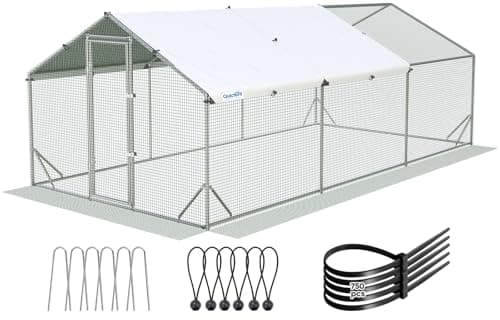
The best walk-in chicken coops and runs
Coops and runs with standing headroom, ranked on height, floor area and whether the mesh is actually hardware cloth.
Start Here
The real cost of raising backyard chickens
A cost framework using live prices and published consumption figures, so the numbers are yours rather than ours.
Hatching & Brooding
How much does an egg incubator cost?
Four price tiers of egg incubator explained by mechanism — manual, auto-turning, auto-humidity and laboratory-grade — with what each step up removes from your daily workload and a live price on every option.