Waterers
The best chicken waterers for large flocks
Past about ten birds the question stops being which waterer and starts being how many gallons, and how many drinking points.
Chickens & Coops earns a commission when you buy through our links, at no extra cost to you. Prices come from Amazon and change; the date beside every price is when we last verified it. Full disclosure.
Quick picks
| # | Product | Capacity | Score | Price |
|---|---|---|---|---|
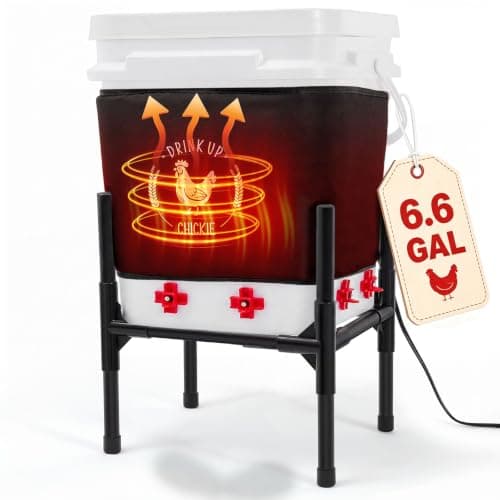
| Rank 1 | 6.6 Gallon Heated Waterer with Stand and 8 Nipples A big flock through a hard winter | 6.6 gallon | 8.6 | $89.99on Amazon |
| Rank 2 | 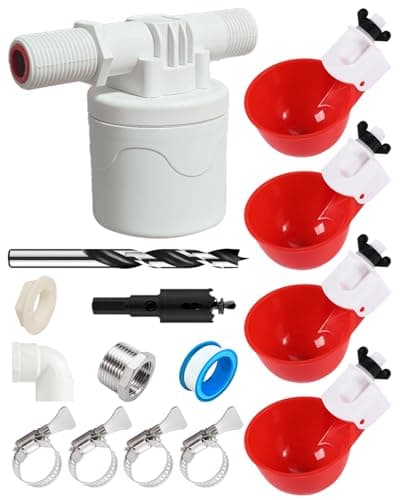 Psarnuk DIY Automatic Waterer Kit, 4 Cups with Float Valve Plumbing the waterer to a hose and forgetting it | Not published | 7.4 | $14.98on Amazon |
| Rank 3 | 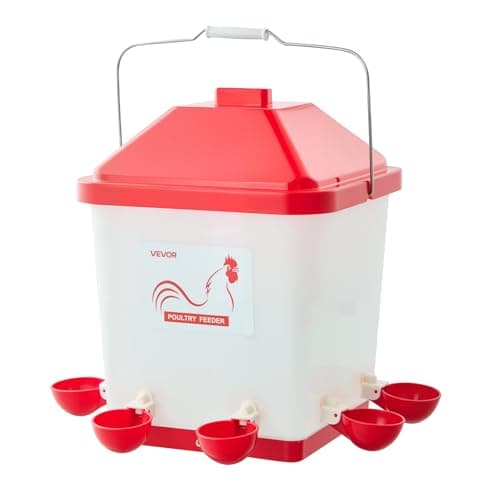 VEVOR 5 Gallon Automatic Waterer with 6 Cups Six automatic cups on one 5-gallon reservoir | 5 gallon | 7.2 | $38.90on Amazon |
| Rank 4 | 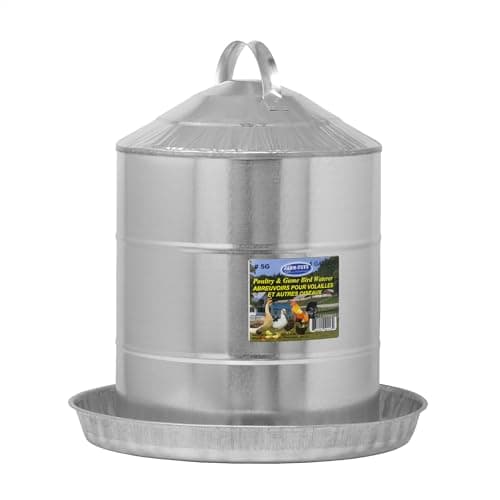 FARM-TUFF Galvanized Poultry Fountain, 5 Gallon A gravity waterer that lasts a decade | 5 gallon | 6.6 | $56.59on Amazon |
| Rank 5 | 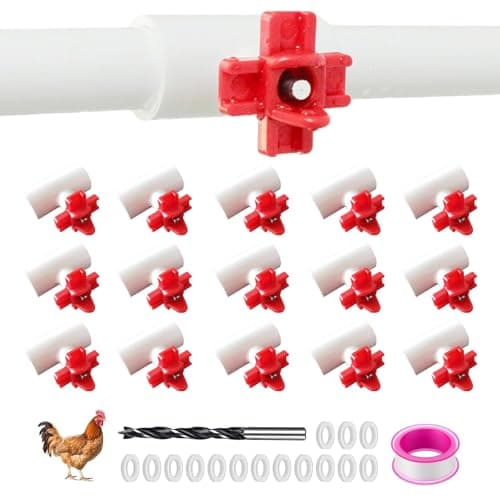 Horizontal Chicken Nipple Kit, 15-Pack with PVC Tee Fittings A DIY nipple system along a run wall | Not published | 6.8 | $16.99on Amazon |
#ad Prices come from Amazon and change. How this site is funded. Scores are our own published rubric, not a lab test — see how we pick.
For a flock of fifteen or more the pick is the 6.6 gallon heated waterer with eight nipples: it is the largest reservoir here, the nipples keep the water clean rather than merely contained, and the integrated heater means the same unit works in January. If your flock is outdoors on a hose line, the Psarnuk float-valve kit is the better answer, because a float valve means you never carry water at all.
The reason large-flock watering needs its own page is that the failure is different. A small flock with an undersized waterer gets a thirsty afternoon. Twenty hens with an undersized waterer get a queue, and in hot weather a queue at the water is a genuine welfare problem — the lowest-ranked birds are the ones that go without.
Start from gallons, not from bird count
A hen drinks about 6.4 fl oz a day in cool weather, and roughly double that when it is hot. That is the figure every row below is built from, and it is the only number you need to size a system.
| Flock size | Cool weather | Hot weather | 3 gal lasts (cool) | 5 gal lasts (cool) |
|---|---|---|---|---|
| 2 hens | About 13 fl oz/day | About 26 fl oz/day | weeks — too big | weeks — too big |
| 4 hens | About 26 fl oz/day | About 51 fl oz/day | about 2 weeks | about 3 weeks |
| 6 hens | About 2.4 qt/day | About 4.8 qt/day | about 5 days | about 8 days |
| 10 hens | About 1/2 gallon/day | About 1 gallon/day | about 6 days | about 10 days |
| 20 hens | About 1 gallon/day | About 2 gallons/day | about 3 days | about 5 days |
Twenty hens is about a gallon a day cool and two gallons a day hot. A 5-gallon fount therefore carries two and a half days of summer water, which is fine if you check it daily and not fine if you are away for a weekend. Note also that the listed capacity is not the usable capacity: a gravity fount stops delivering once the level drops below the trough lip, and an open fount loses some to evaporation and more to bedding.
Drinking points matter as much as gallons
One 5-gallon fount gives a flock a single ring of trough to drink from. Twenty hens cannot all use it, and in heat they all want it at once. The fix is drinking points: cups or nipples distributed along a pipe, or two waterers in different places.
- A working figure is one drinker per three to four birds, so twenty hens want five or more cups or nipples.
- Spread them out. Two waterers at opposite ends of the run does more for a bullied hen than one bigger waterer in the middle.
- Keep one in shade. Hot water is water hens drink less of, and shade is free.
- Nipples stay cleanest. A closed system cannot be fouled, which is the whole argument for them at scale.
The picks
Ranked for a flock of ten or more: usable capacity first, then how many birds can drink at once.
#1 · A big flock through a hard winter
#ad How we are funded · Price as of October 10, 2026
6.6 Gallon Heated Waterer with Stand and 8 Nipples
Generic6.6 heated gallons feeding eight nipples, with four spares. Nipples plus heat is the combination that keeps water both clean and liquid — the only setup here that does both well.
| Capacity | 6.6 gallon |
|---|---|
| Nipples | 8 fitted, 4 spare |
| Stand | Included |
| Heating | Integrated heater |
| Wattage | Not published by manufacturer |
Specifications per Manufacturer figures as published on the Amazon product listing, as published at the date above.
What it does well
- Sealed nipples mean nothing can foul 6.6 gallons of water
- Largest heated capacity here — multiple days for a mid-size flock
- Spare nipples included, which is the part that eventually fails
- Stand included, so it sits at the right height out of the litter
Where it falls short
- Wattage is not published; heating 6.6 gallons is not cheap whatever it draws
- Heated nipples can still freeze at the tip in extreme cold
- Full weight is around 55 lb of water — site it where it will stay
Our rubric
- Capacity
- 10.0
- Stays clean
- 9.0
- Freeze resistance
- 9.0
- Ease of refill
- 7.0
- Value
- 8.0
#2 · Plumbing the waterer to a hose and forgetting it
Psarnuk DIY Automatic Waterer Kit, 4 Cups with Float Valve
PsarnukFour cups plus a float valve, which turns a container into a self-filling trough on a hose line. The only setup here that genuinely never needs carrying water to.
| Includes | 4 cups and a float valve |
|---|---|
| Type | DIY automatic waterer kit |
| Supply | Mains or gravity hose feed |
| Container | Not included |
Specifications per Manufacturer figures as published on the Amazon product listing, as published at the date above.
What it does well
- A float valve on a hose means the water level maintains itself indefinitely
- No carrying buckets, which is the single biggest daily chore in a flock
- Four cups for a small to mid-size flock
Where it falls short
- A hose line must be drained before the first freeze or it splits
- Float valves stick; check it weekly or you get a flooded run
- Needs a container and a hose run you supply
Our rubric
- Capacity
- 8.0
- Stays clean
- 8.0
- Freeze resistance
- 2.0
- Ease of refill
- 10.0
- Value
- 9.0
#3 · Six automatic cups on one 5-gallon reservoir
VEVOR 5 Gallon Automatic Waterer with 6 Cups
VEVORFive gallons feeding six auto-fill cups. Cups keep the bulk of the water sealed inside the drum, which is the main reason cup systems stay cleaner than open founts.
| Capacity | 5 gallon |
|---|---|
| Water ports | 6 automatic-fill cups |
| Operation | Automatic gravity, cup-fed |
| Handle | Carry handle fitted |
Specifications per Manufacturer figures as published on the Amazon product listing, as published at the date above.
What it does well
- Six cups means six hens drink at once without a queue
- The reservoir is sealed, so bedding and droppings cannot get into the bulk water
- 5 gallons on a carry handle is a sensible format for a shed-to-run trip
Where it falls short
- Cups freeze solid before the reservoir does — this is a summer solution
- Cup valves stick if grit gets into them; they need a weekly flick
- Plastic body, so no heated base
Our rubric
- Capacity
- 8.0
- Stays clean
- 9.0
- Freeze resistance
- 2.0
- Ease of refill
- 8.0
- Value
- 9.0
#4 · A gravity waterer that lasts a decade
#ad How we are funded · Price as of October 10, 2026
FARM-TUFF Galvanized Poultry Fountain, 5 Gallon
FARM-TUFFA double-wall galvanized cone-top fountain. Metal is the right choice if you will ever want a heated base under it — plastic founts cannot sit on one.
| Capacity | 5 gallon |
|---|---|
| Material | Galvanized steel, double wall |
| Top | Cone top |
| Operation | Automatic gravity feed |
| Heated base compatible | Yes — metal fount |
Specifications per Manufacturer figures as published on the Amazon product listing, as published at the date above.
What it does well
- Galvanized metal is the only fount body you can legitimately put on a heated base
- Cone top stops hens roosting on it and fouling the water
- Double wall construction means it will outlast several plastic waterers
- 5 gallons is roughly a week for a small flock in mild weather
Where it falls short
- Heavy when full — about 40 lb of water plus the fount
- Galvanized metal reacts with apple cider vinegar, so skip that additive with it
- Cone top makes it awkward to scrub inside
Our rubric
- Capacity
- 8.0
- Stays clean
- 8.0
- Freeze resistance
- 4.0
- Ease of refill
- 6.0
- Value
- 7.0
#5 · A DIY nipple system along a run wall
Horizontal Chicken Nipple Kit, 15-Pack with PVC Tee Fittings
GenericFifteen horizontal nipples with half-inch PVC tees, which is enough to plumb a whole run. Horizontal nipples beat the vertical kind: they do not drip, so the bedding underneath stays dry.
| Pack | 15 nipples |
|---|---|
| Fittings | 1/2" PVC tees included |
| Type | Horizontal side-mount nipples |
| Leakage | Leakproof (manufacturer claim) |
Specifications per Manufacturer figures as published on the Amazon product listing, as published at the date above.
What it does well
- Horizontal nipples do not drip the way vertical ones do, so litter stays dry
- Tee fittings included means you can build a run of pipe, not just one bucket
- Fifteen nipples covers a large flock with spares
- Completely sealed water: nothing can foul it
Where it falls short
- Hens have to learn nipples — keep the old waterer available for a week
- The pipe freezes faster than a bulk reservoir, so this is a warm-season system
- You supply the pipe, the reservoir and the labor
Our rubric
- Capacity
- 6.0
- Stays clean
- 10.0
- Freeze resistance
- 2.0
- Ease of refill
- 7.0
- Value
- 9.0
How they compare for a big flock
| Waterer | Capacity | Drinking points | Lasts 20 hens (hot) | Heated |
|---|---|---|---|---|
| 6.6 Gal Heated, 8 Nipples | 6.6 gallon | 8 nipples | About 3 days | Yes |
| Psarnuk Float Valve Kit | Depends on container | 4 cups | Indefinitely, on a hose | No |
| VEVOR 5 Gal, 6 Cups | 5 gallon | 6 cups | About 2.5 days | No |
| FARM-TUFF Galvanized Fountain | 5 gallon | 1 trough ring | About 2.5 days | Base-compatible |
| Horizontal Nipple Kit, 15-Pack | Your reservoir | 15 nipples | Depends on reservoir | No |
The three ways to water a big flock
One big reservoir
Simplest, and the right choice if the flock is in a fixed run and you do not have a tap nearby. Buy more gallons than the arithmetic says you need, because the bottom inch of any gravity fount is not usable and because a hot spell doubles consumption without warning.
A reservoir plus distributed nipples
A bucket or drum feeding a run of pipe with horizontal nipples along it. This is the cleanest system available at any flock size: the water is sealed, so it cannot be fouled with bedding or droppings, and nipples spread the drinking points out so nobody queues. The trade is that hens take a week to learn nipples, and the pipe freezes long before a bulk reservoir does.
A float valve on a hose
The only setup that removes the chore entirely. A float valve maintains the level in a container from a hose line, exactly like a toilet cistern, so the flock's water never needs carrying. Two cautions, both learned the hard way: float valves stick, so check it weekly or you get a flooded run, and the hose line must be drained before the first hard freeze or it splits.
Winter at scale
A large flock makes the winter water problem worse, not better: more gallons to keep liquid, and more refills if you are carrying warm water out twice a day. The 6.6-gallon heated drinker at the top of this list exists precisely for that, and heated waterers covers the smaller options. If the coop has no power, a heated waterer is not available to you and the honest answer is the no-electricity approach plus more frequent visits.
Two waterers or one bigger one?
For a large flock, two is usually the better answer, and the reason is social rather than hydraulic. A flock has a pecking order, and a single watering point is a place the dominant birds can hold. With two waterers at opposite ends of the run, a hen being kept away from one has somewhere else to go, and you also get redundancy: if one tips, fouls or freezes, the flock is not waterless until you notice.
The argument for one big reservoir is the chore. One fill is quicker than two, and a single 6-gallon drum holds more usable water than two 3-gallon founts because less of the total sits below the trough lip. The split most large-flock keepers end up at is a big primary reservoir plus a small secondary one in a different spot — the second is there for the bullied bird and the bad day, not to carry the flock.
What usually goes wrong at scale
- Sizing from the cool-weather figure. The waterer that lasted four days in April runs dry in two on the first hot weekend.
- One drinking point for twenty birds. It works, in the sense that nobody dies, and the lowest-ranked hens drink less than they should all summer.
- Leaving a hose line connected into winter. A float valve is the best large-flock upgrade there is, and a hose left charged through a hard freeze splits.
- Scaling capacity but not cleaning. Biofilm grows on a schedule set by temperature, not volume. A 6-gallon drum needs the same weekly scrub a 2-gallon fount does.
- Siting it on soft ground. Six gallons is fifty pounds. A full drum on wet soil tips, and it tips when the ground is softest, which is the week you least want to be carrying water.
The other thing that scales with flock size is feed. Twenty hens get through 5 lb a day, which is a 35 lb week — feeders sized for a double-digit flock runs the same arithmetic on the feed side.
Frequently asked questions
How much water do 20 chickens need per day?
How many waterers do I need for a large flock?
What is the best waterer for 20 chickens?
Are nipple waterers good for large flocks?
Do I need a heated waterer for a big flock?
Sources
Read next
Waterers
The best chicken waterers
Our main waterer ranking: open founts, cup systems and nipple kits, judged on cleanliness as much as capacity.
Waterers
How much water do chickens drink?
The published water-intake figures, a table by flock size, and why hot weather is the number that matters.
Waterers
The best chicken nipple waterers
Horizontal nipple kits: the cleanest water on the site, the cheapest parts, and the honest winter caveat.
Waterers
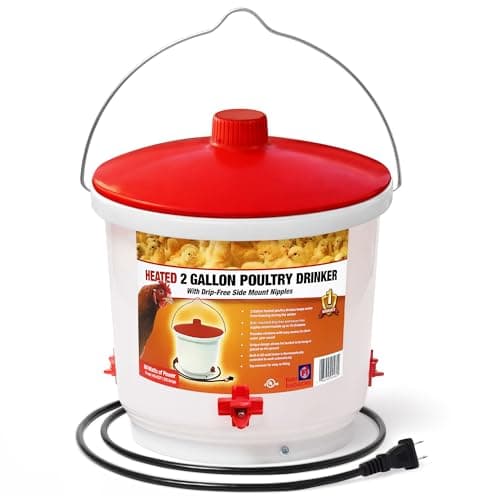
The best heated chicken waterers
Heated drinkers and heated bases, ranked on published wattage and thermostat control — the two figures that matter.
Feeders & Feed
The best chicken feeders for 10 chickens
Ten hens get through roughly 2.5 lb of feed a day. Five feeders sized for that, from a 40 lb treadle hopper down to a twelve-port hanging feeder.